

Hi Partner 👋
I hope you are doing well.
Today it’s time to talk about growth investing.
In today’s interview you’ll learn how Kris was able to generate a +8,720% (!) return on Nvidia and a +2,668% return on Shopify.
Do you want to know what the best growth stocks are now?
Discover Kris’ favorite growth stocks right now here:

Who is Kris Heyndrikx?
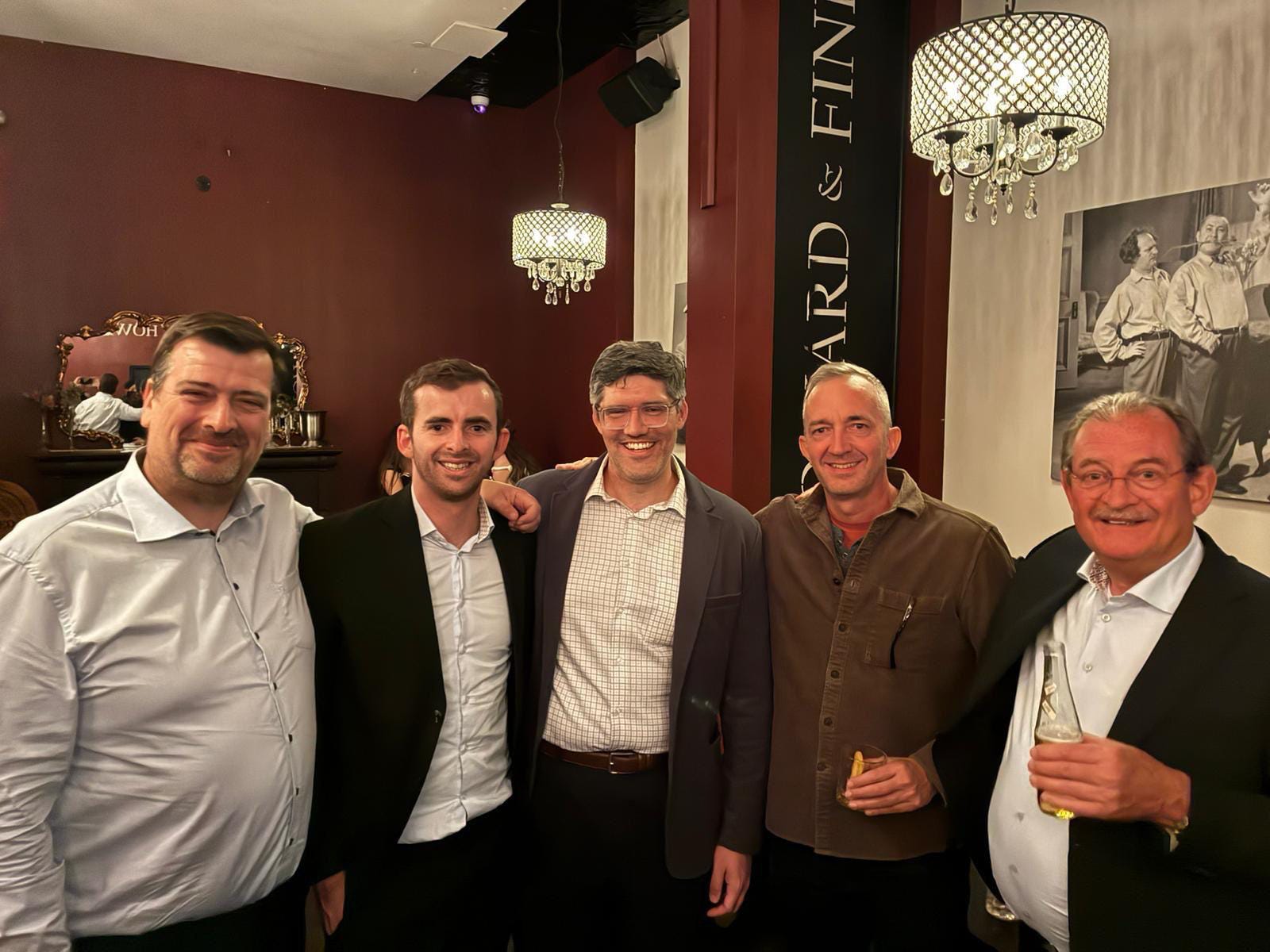
Kris Heyndrikx is one of my best friends.
We talk about business, life and investing every single day.
Kris is best known for his Twitter Account From Growth To Value (120.000 followers) and his investment newsletter Potential Multibaggers.
His newsletter is focused on growth investing.
Kris bought:
Shopify ($SHOP) for $5.6 (current stock price: $155)
Cloudflare ($NET) for $39 (current stock price: $310)
Crowdstrike ($CWRD) for $24.53 (current stock price: $225)
On top of that he also identified Nvidia ($NVDA) early.
Let’s now dive into this two-part interview!
How would you define your investment strategy?
Kris: I look for high-quality disruptive businesses that have the potential to go 10x or more over the next 10 years. Of course, these are not so easy to find. But when I find them, I do the hardest thing in investing: I hold them as long as they execute.
By the way, I’m pretty happy with a 5x return too. A 5x means you generate an average return of 17% per year for 10 years. A 10x means you generate a return of 26% per year for 10 years. This math shows you don’t have to gamble or trade to get fantastic results. You need to find a truly great company early and then give it the time to keep growing. Sometimes, you are surprised to the upside. I wouldn’t have expected Shopify to go more than 20x in the 9 years since I bought it.
Your Twitter handle is ‘From Growth To Value’. Could you elaborate on this?
Kris: My Twitter/X name is basically my entire philosophy in four words. I try to buy growth stocks and hold them so long that they become value stocks. When I started writing about stocks, in February 2016, Amazon ($AMZN) and Netflix ($NFLX) were still seen as high-growth stocks and way too expensive. Today, they are considered growth at a reasonable price. The next step is a value stock, like Google ($GOOG) was when everyone thought AI would kill it. Because I follow AI closely, I bought a position in Google at that point in time.
That journey, from growth to value, is where you can find life-changing returns. If you can hold a great stock for 30 years, the returns can become almost absurd. I know someone who invested about $1,500 in Netflix when he got out of college. He was thrilled when he could sell at a 40% profit the next year. That’s what most investors are happy with. But had he simply held his Netflix shares, that small position would be worth around $1.5 million today, and that’s with Netflix down almost 50% from its top right now. That’s the difference between OK returns and life-changing returns. That’s why I want to buy growth stocks and hold them as long as the fundamentals stay intact.
What do most investors simply get wrong about growth investing?
Kris: They think it’s all about adrenaline, jumping in and out of positions, chasing meme stocks, catching the next hype, ... But that’s not growth investing, that’s trading, and it’s a completely different game with much worse outcomes.
Finding a great growth stock is just 10% of the work, and it’s the easiest part. Holding it is where the real money is made, and holding is much, much harder than it sounds. When your stock is down 50% or 70% and all the headlines are negative, doing nothing takes more strength than acting.
Most people want to get rich fast. But time is your best friend in investing, and that is even more important for growth investing. Most people don’t have the patience, and that’s why they sell a future 100-bagger for a 40% profit. Charlie Munger said the most important rule of compounding is to never interrupt it unnecessarily. For growth stocks, with their higher returns, interrupting the compounding can even be more expensive than for quality stocks.
Take us through how an idea becomes a position. From discovering the company to pulling the trigger. Feel free to use a concrete example.
Kris: The process from idea to position is pretty slow for me, unlike what you may expect if you think growth investing resembles trading. My ideas come from everywhere: a post on X, one of my subscribers, a conference, a podcast, reading, ...
The first filter is extremely simple: what does the company do? I have to be really interested in what the company does. Why? Because boredom is an enemy in growth investing. I’m very curious about our future, and if I don’t get excited about what a company does, it’s often a sign that its future may not be that great. For a growth stock, that’s a huge red flag. On top of that, I follow up the companies in my portfolio very closely and write deep dives on all my Potential Multibagger stocks very quarter. If I’m not interested enough in what the company does, it’s impossible to do that. When I am interested, following up makes me feel like a kid in a candy shop, when I’m not interested enough, it feels like having to clean your toilet with a toothbrush.
That’s why there are industries I stay away from. Energy, for example, unless something is truly disruptive. Financials too, normally. But one of my picks is a disruptive bank: Nubank ($NU), already more than a three-bagger in three years. So, as you can see, this is not an absolute criterion.
I also have to see real growth potential in the market the company is operating in. If the overall pie is shrinking, even a great company is swimming against the current, and finding winners becomes much harder.
When a company has passed the first filter, 90% is already gone and they never make it to the second step, in which I look at revenue growth. I want at least 20%+ consistent revenue growth.
When that is the case, I apply the third filter: Management quality.
Only when a stock survives those three filters, the real research start. I read everything I can find: Conference calls, analyst days, the 10-Ks, the S-1s, interviews with the CEO, podcasts about the company and so on. And only if all of that is positive, I make it a pick and start writing my articles (I usually write 5 articles for a new pick). Then, my subscribers can buy to start a position and a day later or so, I also start a position.
You bought Shopify and Nvidia early. Looking back, what did you see that most of the market missed?
Kris: The story is maybe not that glorious as you may think. I picked Shopify ($SHOP) in February 2017 for my personal portfolio, at a split-adjusted price of $5.58. I had just listened to Tobi Lütke, the founder and CEO on a podcast, and I thought he was brilliant. So, in an impulse, I bought some Shopify shares.
After the initial good feeling, the regret came. I hadn’t followed my process, had not used my ratio but bought based on what I considered superficial emotions, like an amateur. I had not checked the valuation and I really thought I had acted stupidly. But I started analyzing why I bought the shares anyway. The more I thought about it, the more I saw that while the process was bad, the stock could be great.
That research period was the start of Potential Multibaggers. If I was this intrigued enough by this man from just a podcast to buy shares of his company, wouldn’t other people be attracted to him in real life? Probably his customers, his employees, his financial backers also thought he was fantastic and wasn’t that a very strong asset to have that you can’t see on any balance sheet?
That’s when I got an idea that changed my investing forever. There is very valuable knowledge in finance that almost nobody uses, because it is not seen as “real” knowledge: emotional intelligence. We all see things we can’t fully rationalize: you meet someone and you know this guy is brilliant, and if I ask you how you know, you can come up with rationalizations of your feeling, but the real answer will still be that you just knew.
Can you elaborate a little bit on this ‘emotional intelligence’?
Kris: Only about 10% of our knowledge is conscious, while the rest is subconscious. That unconscious knowledge is the collection of every lesson we’ve learned from the day we were born until now. And that knowledge is surprisingly accurate when it comes to certain subjects, better than the praised ratio. While there are some individual differences, most people are good at judging other people. And that’s great, because companies are made by people. You can have two identical companies and one will fail and one will become the best in the world. The difference is in the people that make the company.
Rational knowledge is often treated as the only reliable source of knowledge in investing. I think that’s a mistake. For months, I went into research mode and I looked back at the greatest investments ever. They were all connected to people. Apple with Steve Jobs. Amazon with Jeff Bezos, Tesla with Elon Musk, Walmart with Sam Walton, Berkshire Hathaway with Warren Buffett and Charlie Munger, and so on. The pattern was clear: a visionary founder CEO bringing an outsider’s view to an industry that hadn’t changed in ages often succeeds. So I made that one of my criteria.
After Shopify, which other stocks did you buy?
Kris: Three months after that impulse buy, on May 2, 2017, I started Potential Multibaggers, with Shopify as the very first pick and now with a much better process and patterns to look for.
I bought Nvidia in 2017 as well. I bought it for my own portfolio at a split-adjusted $2.50 or so, but I never made it an official pick. I thought it was already too big at around $60 billion, while Shopify only had a market cap of $4.5 billion at the time.
It’s pretty crazy that Nvidia became so big. The reasons why I bought Nvidia shares were, in that order, its founder and CEO Jensen Huang and the fact that they started talking about AI. In 2016 already, the company opened its press releases with “NVIDIA is the AI computing company.” That really convinced me already back then. Usually, there are signs like that, but you have to follow a company closely to see them.
I think what I saw that the market didn’t see was that these men had a vision for the future of their sector and the ability to execute that vision.
What’s a call you made that, in hindsight, you’re most proud of, not just because it worked, but because of how contrarian or hard it was to make at the time?
Kris: Shopify again, and this time because of what happened right after I picked it. A few weeks after I made it the first Potential Multibaggers pick, Citron Research came out with a short report about Shopify. Citron doesn’t have a great reputation anymore, but at the time it did, and I was pretty scared when I read the full report.
You know how it goes with short reports: if you are still relatively new to investing, you’re blown away by all the negativity and the strong words. So after reading it, I was even more worried. But then I started checking if what was written was actually true. And I thought it wasn’t. There was a lot of insinuation, but no substance. So I decided to buy more. Then Citron came with a second short report, and I think a third as well, and I bought more each time. I wasn’t that experienced with short reports yet, so I’m pretty proud of that one.
You’re a big fan of dollar-cost averaging. Could you elaborate on why you buy stocks every two weeks, plus ‘DCA on steroids’?
Kris: Dollar-cost averaging means investing the same amount every two weeks, every month, every quarter, whatever you choose. I do it every two weeks.
I allocate my money to the companies that perform well, but you cannot always judge that at a certain moment. You need time to see if an ambitious management plan works out, to see if revenue growth stays high, if margins develop in the right direction, if there’s enough innovation and so on and so on. That’s why I love DCA. For some companies, Shopify, Cloudflare, CrowdStrike, I have probably bought more than 50 times over all those years.
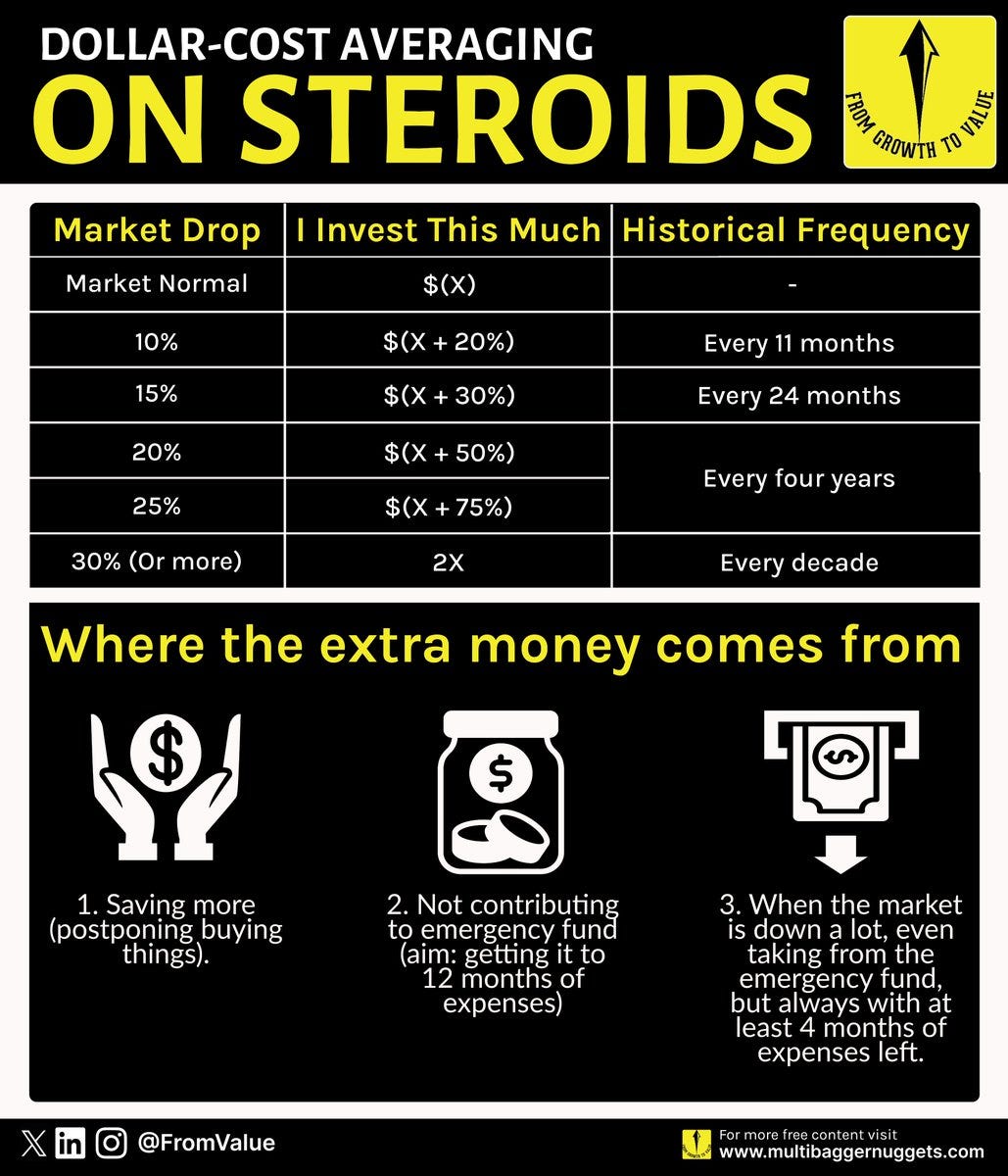
I also developed dollar-cost averaging on steroids: if the market drops, I invest more. And to be clear, I’m talking about the S&P 500 here, not my own portfolio. If the S&P 500 is down 10%, I try to invest 20% more, if it drops 20%, I invest 50% more and if it’s down 30%, I try to double the money I invest. That’s possible because I’m still in my earning phase. If you have a closed portfolio, without money coming in, this works differently.
I also use dollar-cost averaging for big lump sums. If you get an inheritance or a big bonus, I would divide it and invest it in 52 times, so over 2 years, every two weeks, unless the market drops substantially, of course, as the DCA on steroids then kicks in.
Yes, if you look at the research, lump-sum investing has the highest return on average. But it’s not the average that counts, it’s your portfolio that matters to you. If you dollar-cost average, your returns will be almost as high as lump-sum investing, but they will be much higher than trying to time the market. Waiting for 52-week lows to invest usually gives you lower returns than just investing every two weeks. Why? Because the market goes up on average.
Conclusion
That’s it for today.
As this interview is quite extensive, you’ll receive Part II next Tuesday.
Did you like this?
Discover Kris’ favorite stocks here:
Everything In Life Compounds
Pieter
Book
Order your copy of The Art of Quality Investing here
Used sources
Interactive Brokers: Portfolio data and executing all transactions
Fiscal.ai: Financial data
The part I find interesting with 100-baggers is how different the stock-level result can be from the portfolio-level result. Finding one is obviously extraordinary, but if it starts as a tiny position it may still contribute less than a repeatable strategy applied to meaningful capital. For me the more useful question is what characteristics create persistent compounding, and how much conviction you can rationally allocate before hindsight makes the winner look obvious.
The Google detail is the one we would underline. Buying it when the consensus was that AI would kill search is your growth-to-value thesis running in reverse, and it's the same trade Berkshire just made at scale, anchoring Alphabet's raise at $348 to $352 in June after tripling the position since Q3 2025. Two very different processes, yours emotional-intelligence led and theirs valuation-discipline led, arriving at the same name.
On the Nvidia tell: opening press releases with "NVIDIA is the AI computing company" in 2016 is a great example of a company telling you what it is before the market prices it. Is there a current holding where you've spotted that kind of self-description running ahead of the narrative?