

Hi friend 👋
Let me ask you a question.
What’s the best way to compound wealth predictably?
We will start with the popular opinion in today’s market.
18-year-old TikTok Influencers say: “Quality investing is dead.”
They tell you the advice in Graham’s Intelligent Investor is outdated
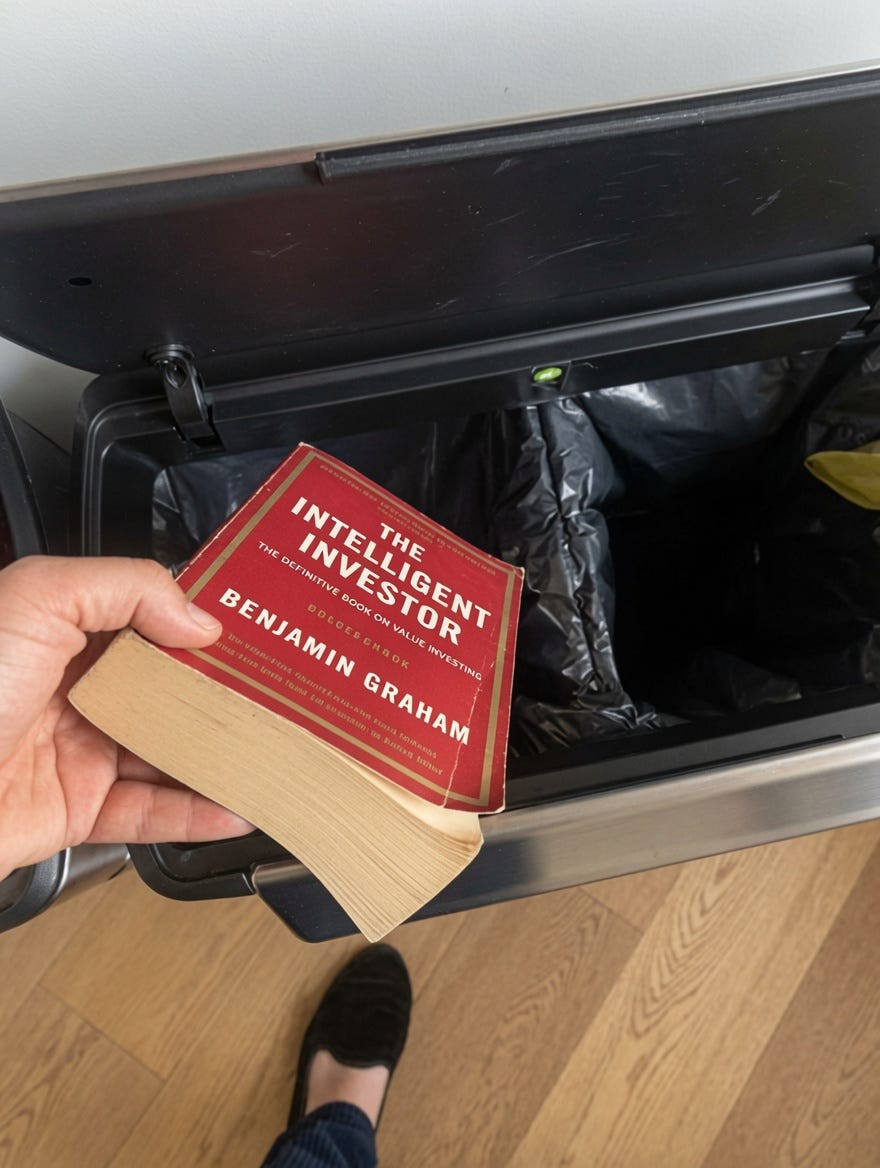
And they confidently suggest, “If you want to get rich, just follow the trend.”
Right?
After all, high-quality stocks are trading at all-time lows.
Whereas low-quality stocks are trading at very lofty premiums.
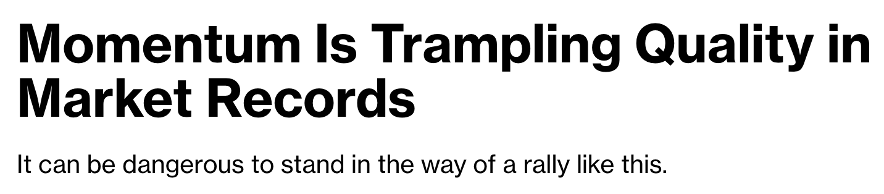
Indeed, these are challenging times for quality investors.
It’s only natural to worry about your investments.
However, before you make any drastic decisions, please hear me out.
You may not know it yet.
But the low valuations in quality stocks are a big opportunity for rational investors.
Especially if you know how to take advantage of this.
Most investors are chasing momentum stocks right now.
They’re buying shares in companies they know nothing about.
They’ll eventually have regrets. But I don’t want that for you.
That’s why I’m writing this exclusive update.
I’m going to share a mental model for going through times like this.
You see, I was in Omaha for the 2026 Berkshire AGM.
This is the fourth year in a row that I’ve gone.
It’s like a yearly pilgrimage.
During the meeting, Warren Buffett said something you may agree with.
This headline summarizes it perfectly:

The keyword here is GAMBLING.
Speculative behavior is now worse than ever before.
For most investors, business fundamentals don’t matter anymore.
Just look at the SpaceX IPO.
Herd instinct tells you to focus on the short-term movement of stock prices.
It encourages you to ignore dangerous risk factors in a company’s annual report.
And it makes you think there’s nothing wrong with embracing the greater fool theory.
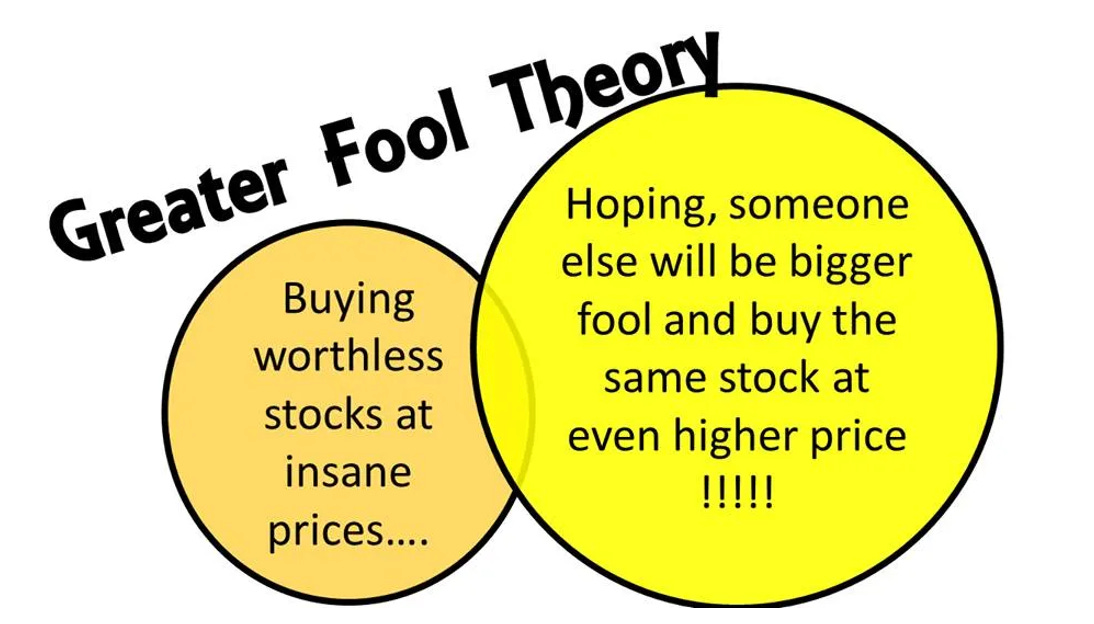
Who cares if a company can’t pay off its debt?
Just follow the trend and buy if the stock is going up and up.
This is the gambling trap Warren Buffett warned us about.
In times like this, stock prices disconnect from business fundamentals.
That’s why you see shares of mediocre companies hitting new highs every month.
You could easily do what everyone else is doing if it pleases you.
However, if your goal is to significantly outperform the market in the long run…
Here’s something to consider:
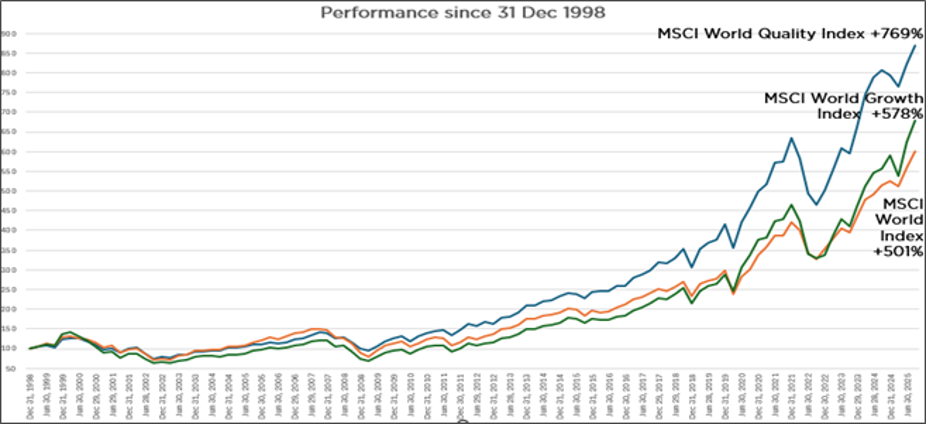
High-quality stocks might be having a hard time right now.
But in the long run?
They significantly outperform the market:
A good example is Berkshire Hathaway.
The company invests in established (but undervalued) businesses.
Just like we do at Compounding Quality.
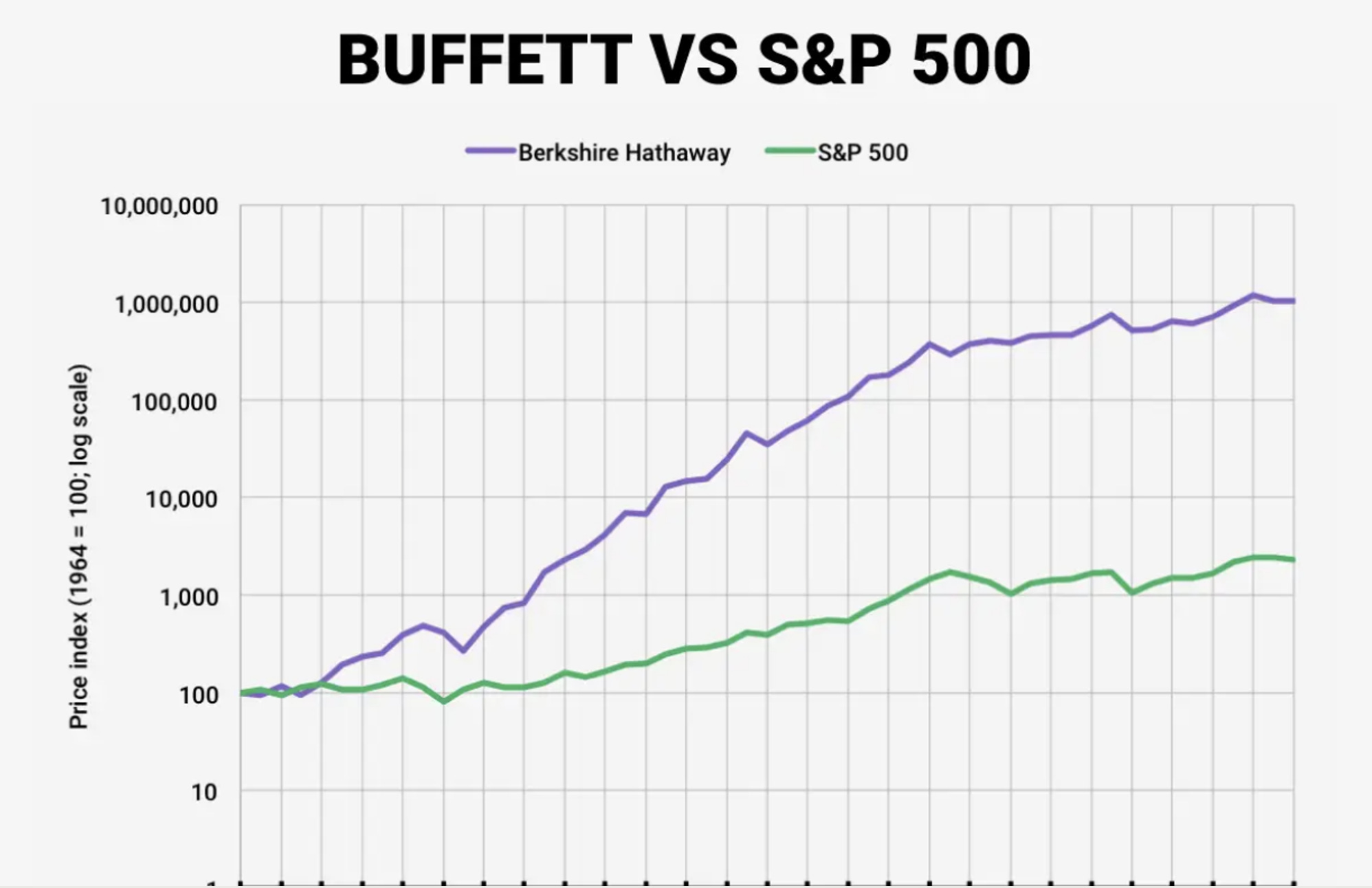
Since 1962, Berkshire has returned over 5 million percent to investors.
Let that sink in.
5,000,000%.
That’s a compounded annual return of nearly 20%.
This is around double what you get from the S&P 500 Index.
In fact, looking at the cumulative returns over the last six decades…
You could erase 99% of Berkshire’s returns and still outperform the S&P 500.
Can you get similar returns chasing meme stocks?
Let’s make the math more specific.
Suppose you invested $10,000 in 1962.
In that case, you’d have $6 million today if you invested in the S&P 500.
But what if you invested in Berkshire Hathaway instead?
In that case, you’d have $3.6 billion!
The difference is ridiculous.
It is due to the power of compounding quality over long periods.
However…
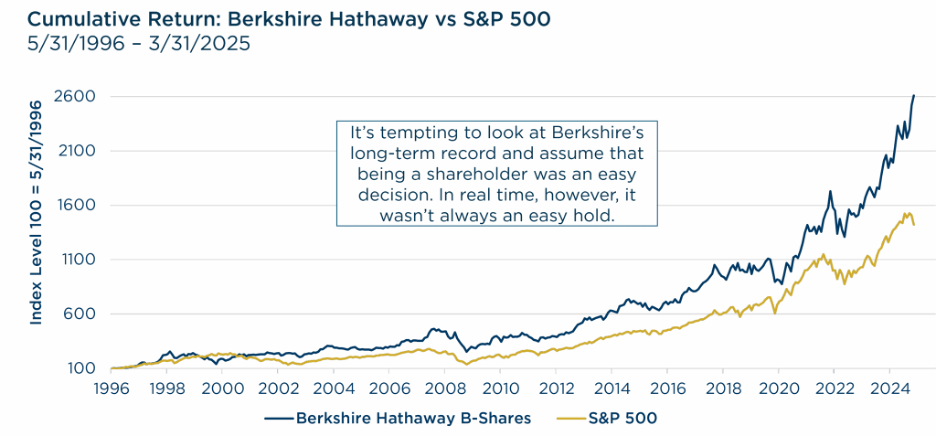
As good as Berkshire’s returns look now, it wasn’t an easy ride for investors.
The conglomerate had some years where it underperformed the market.
During those periods, it was tough being a quality investor. Just like today.
You may remember what happened in 1999.
It was the peak of the dotcom bubble.
Berkshire refused to buy mediocre businesses at unreasonable prices.
People were saying Buffett had lost his magic touch.
So they sold their Berkshire shares, and the stock suffered.
But if you invested $10,000 in Berkshire in 1999...
Your investment would be worth around $400,000 today.
A 40-bagger (!)
You would have outperformed the S&P 500 2x!
It’s what you can expect from quality stocks backed by strong fundamentals.
Why great companies underperform in the short term
Great companies often underperform in the short term for reasons unrelated to their fundamentals.
Smart management teams prefer waiting for the right opportunities instead of making average investments just to show growth.
They focus on long-term projects, but many investors lack the patience and instead chase trendy, fast-moving stocks
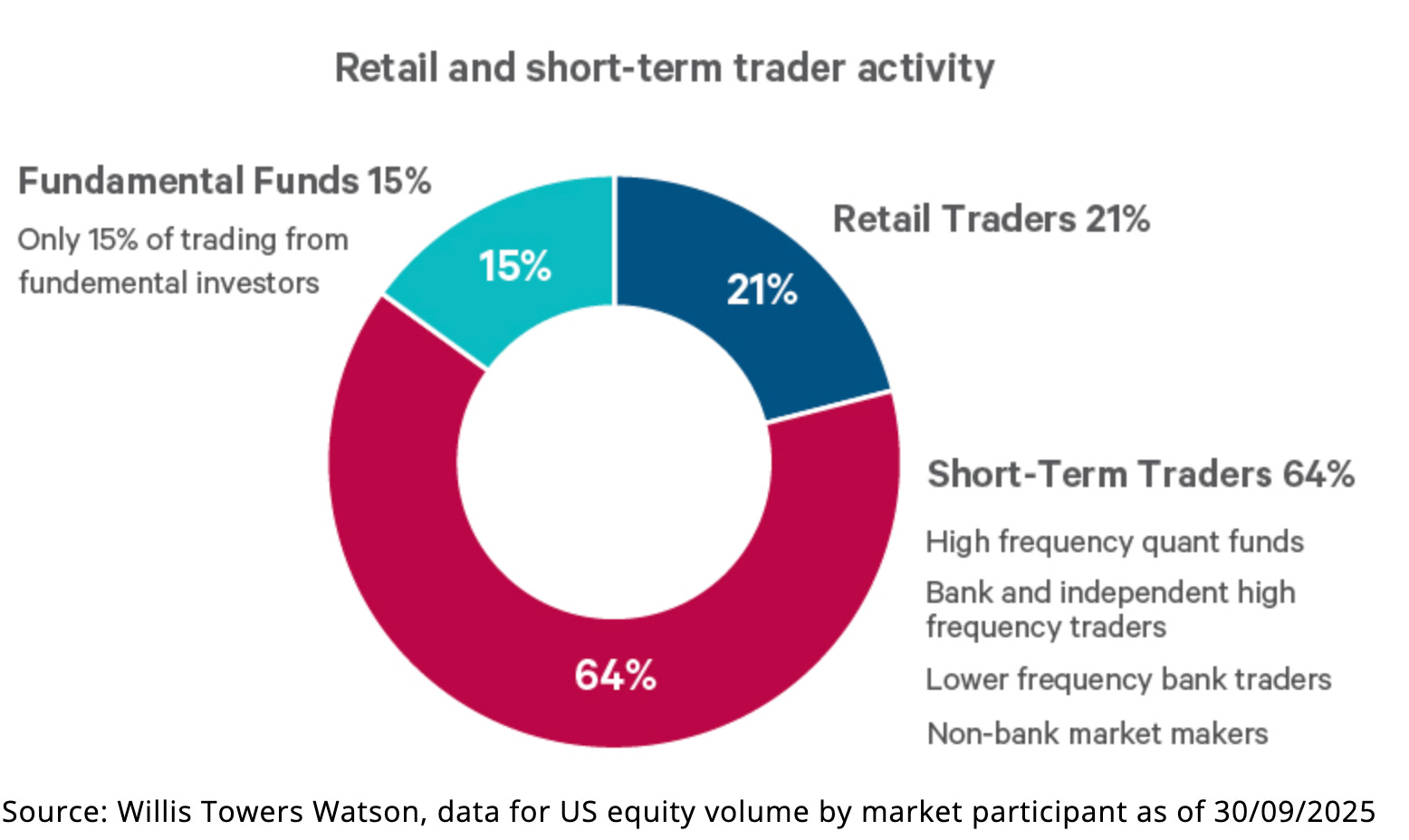
Sometimes, market sentiment also shifts toward riskier sectors, causing quality businesses to temporarily fall out of favor.
So short-term underperformance is often more about investor behavior than business fundamentals.
But it goes even deeper.
How Quality performs during downturns
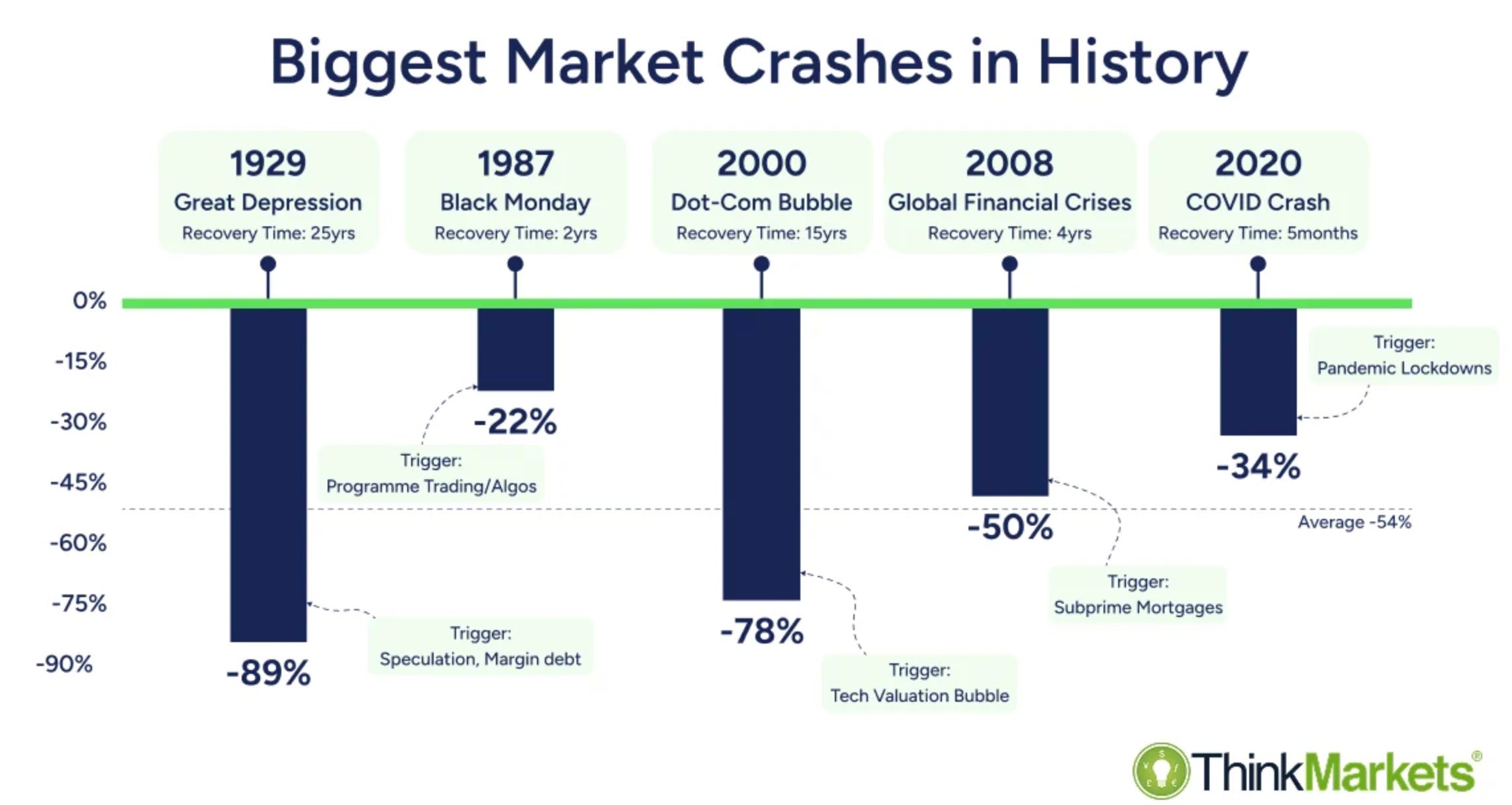
Pick any financial crisis that comes to mind:
The dotcom crash
The global financial crisis
The COVID meltdown
How did quality stocks perform?
They fell less than the broader market.
And they recovered faster.
That’s exactly what makes the strategy so powerful.
Here’s a study you may find interesting:
An investor compared quality stocks versus momentum stocks.
You know what he learned when the market crashed?
Quality stocks recover 9x faster than other stocks.
And when they recover, they reach new highs, massively outperforming the market.
That’s why I’m so optimistic about the companies we own.
Our philosophy is very similar to Warren Buffett.
We will own our companies for a long time.
Why?
Because they meet the criteria to outperform in the long term:
A strong moat
High profitability
Low capital intensity
Great capital allocation
High management integrity
Attractive historical growth
Benefiting from major economic shifts
These companies may struggle when the market is in a gambling mood.
Like today.
Many investors are paying lofty premiums for low-quality stocks.
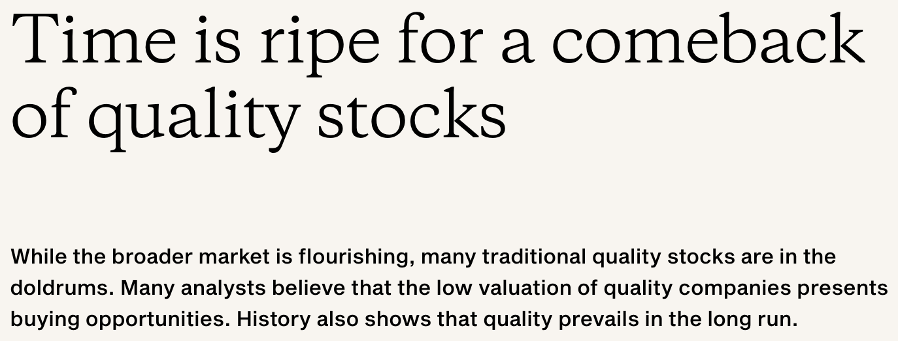
But sooner or later, stock prices reconnect with business fundamentals.
And when this happens?
Quality stocks soar to new highs, handing you incredible returns.
Buy the best of the best at a discount
World-class companies almost never trade at a discount.
But when they do?
You should take full advantage of the opportunity.
When you don’t understand a business, a falling stock price looks like a warning.
However, when you know the business fundamentals are still intact?
You don’t panic.
Instead, you could do one of two things:
Hold onto your current positions.
Buy more.
Here’s a simple strategy you can use to your advantage.
Adding Every Month (Dollar-Cost Averaging)
Two things happen when you add to your portfolio every month:
If the stock market goes up, you make money
If it goes down, you can add to your portfolio at lower prices.
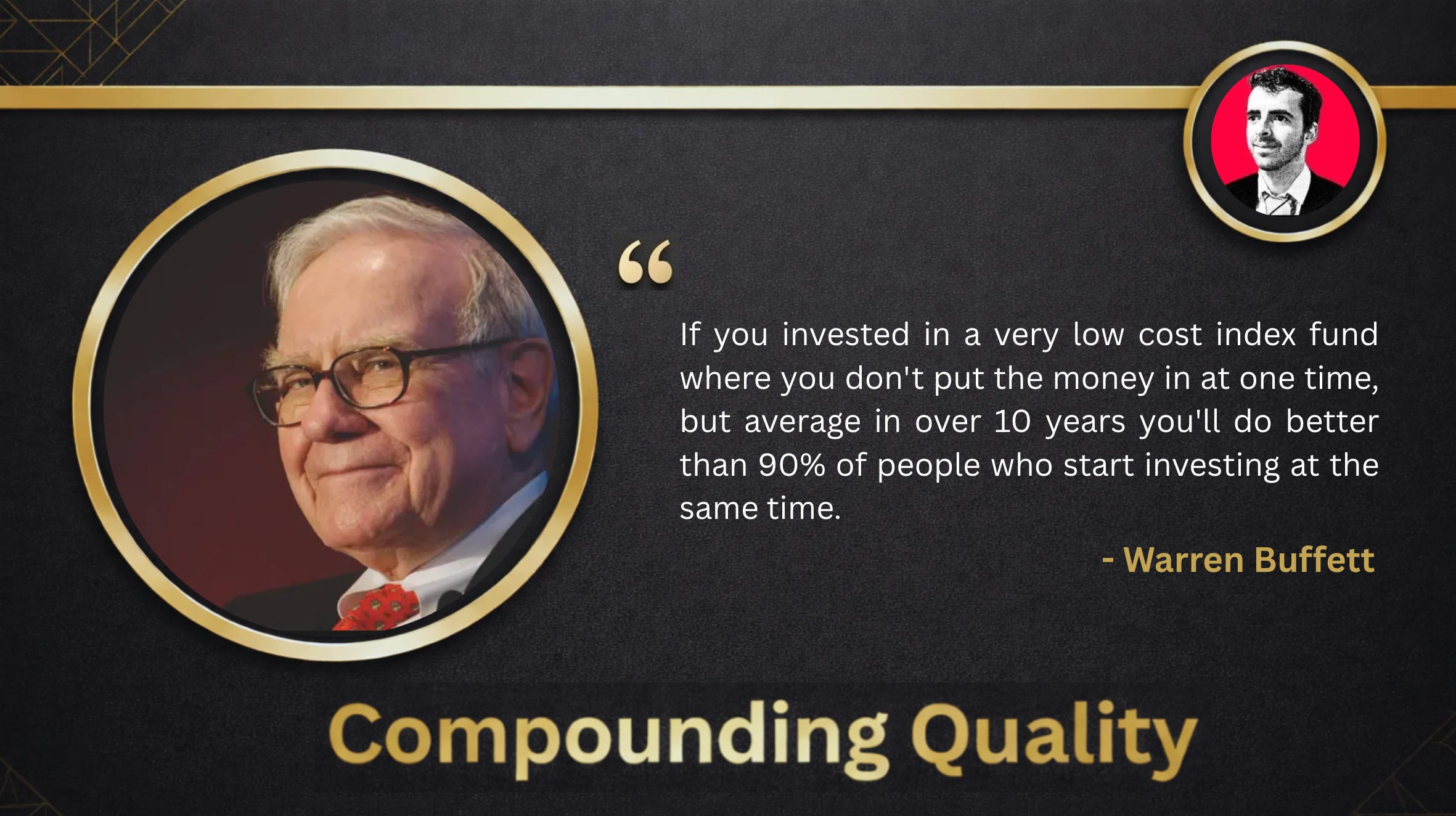
Here’s how we do it at Compounding Quality:
We add around $50,000 to our Portfolio every month.
Currently, our positions are worth $1.5 million.
And I want to keep investing for as long as I can.
How will we do if we stick to quality stocks forever?
Look at it this way.
Warren Buffett is 95 years old.
Me?
I’m 29.
Suppose I live as long as the Oracle?
That means I have 66 years left to invest.
Now, let’s use a conservative CAGR of 12%.
Assume I don’t make any additional stock purchases.
After 66 years, Our Portfolio would be worth $3.8 billion in that case.
Not bad.
But can we do better?
What if I keep adding $50,000 to our Portfolio every month?
Over the next six decades, it would be worth $17.5 billion.
That’s just ridiculous.
This is the magic of compounding at work.
Are you taking full advantage of it already?
If not, this is a good time to do so.
Why?
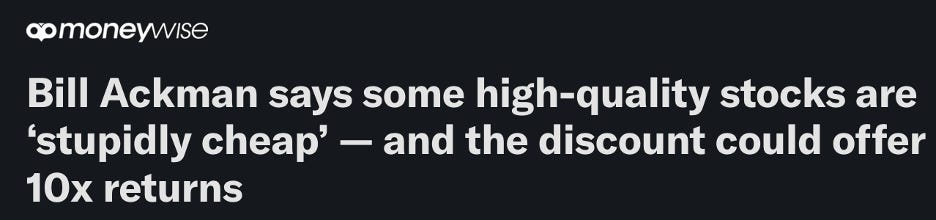
Because high-quality stocks are “stupidly cheap” right now.
My suggestion?
Take advantage of the low prices today.
You may have to sit through periods of volatility.
But here’s what I’ve learned in over a decade of quality investing:
Buying quality stocks at a discount sets the foundation for superior long-term returns.
Is it a popular approach?
No.
But it’s probably the safest way to compound wealth predictably.
Everything in life compounds
Team Compounding Quality
PS You are not a Partner of Compounding Quality yet? Discover everything you need to know here.
Book
Order your copy of The Art of Quality Investing here
Used sources
Interactive Brokers: Portfolio data and executing all transactions
Fiscal.ai: Financial data
Hi, good write up thanks. What low quality companies are you signaling? As I know the companies that are moving the market are high quality companies like Nvidia, Google, etc., other different thinhg is valuation and expectation on their future earnings. Can you give some examples of low quality companies that investors are chasing today? I agree that there are companies that used to have a strong moat that are trading at historic low multiples, but the risk of disruption is on the table too. Just curious because I am not currently invested in the major companies in the S&P, looking for quality and higher predictability. Thanks
Pieter — this is the piece I needed to read, and I still can't fully settle. So let me push back in good faith.
My fear was never that I'd turn into a sheep chasing SpaceX. It's the opposite: "don't be a sheep" can become its own flock — the quality crowd reaching for the same Berkshire chart every time it underperforms. The honest alternative to our 18 names was never meme stocks. It was the index. And as Maria notes above, the names leading it — Nvidia, Alphabet, Microsoft — aren't junk; they're elite businesses. So the real question isn't quality vs. gambling. It's concentrated quality vs. the index — and since Jan '25 that's roughly −23% for us against +28% for the S&P. That gap compounds too.
Two things I can't get past:
— Berkshire is one survivor, and most of that ~20% was earned when it was small. "Price reconnects with value" is true on average — but it doesn't tell me whether Novo or Zoetis are mispriced, or simply re-rated for slower growth.
— "Hold or buy more" has no falsification test. Where's the line where patience becomes ego refusing to mark a mistake? I'm trimming my own oversized Novo and Evolution precisely because I can't find that line — so I'm asking you as much as myself.
Are we optimizing to compound capital, or to be proven right? Thanks for making me wrestle with it.