

Dear Partner 👋
Some of the world’s best quality investors? Akre Capital Management.
They have compounded capital at 12.4% over the past 15 years.
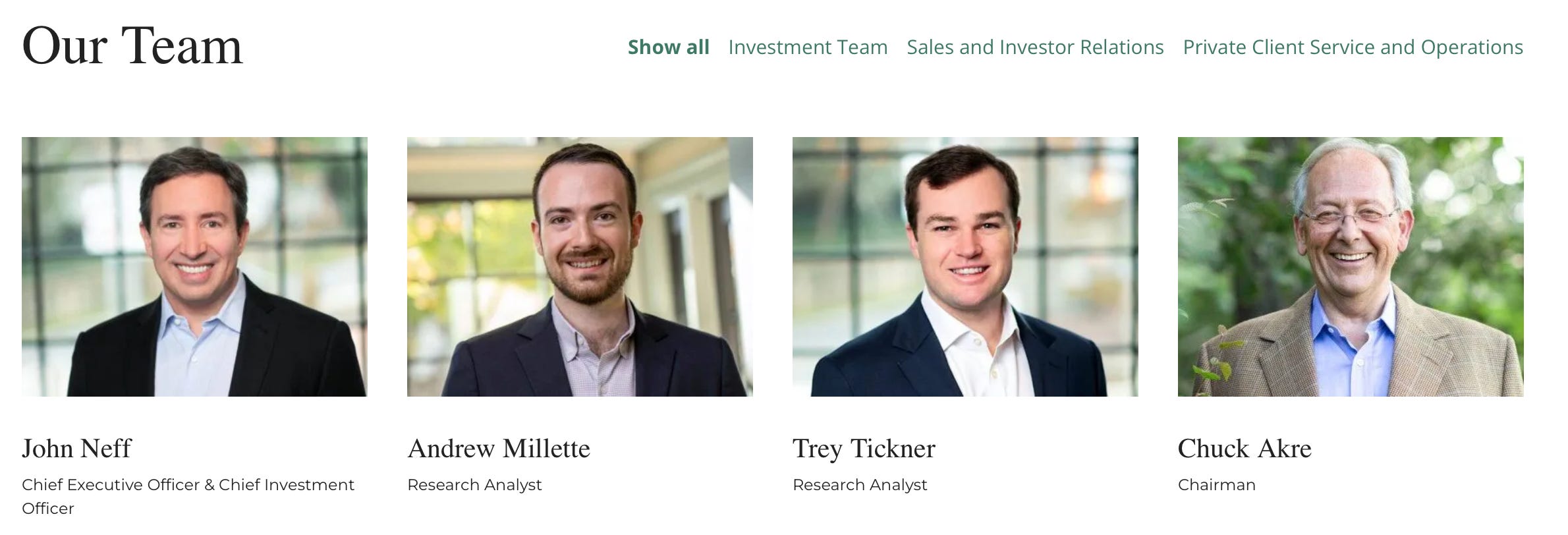
Recently, we had the honor of sitting down with the investors behind Akre Capital Management:
John Neff
Andrew Millette
Trey Tickner
Let’s share their amazing wisdom.
The famous “Three-Legged Stool”
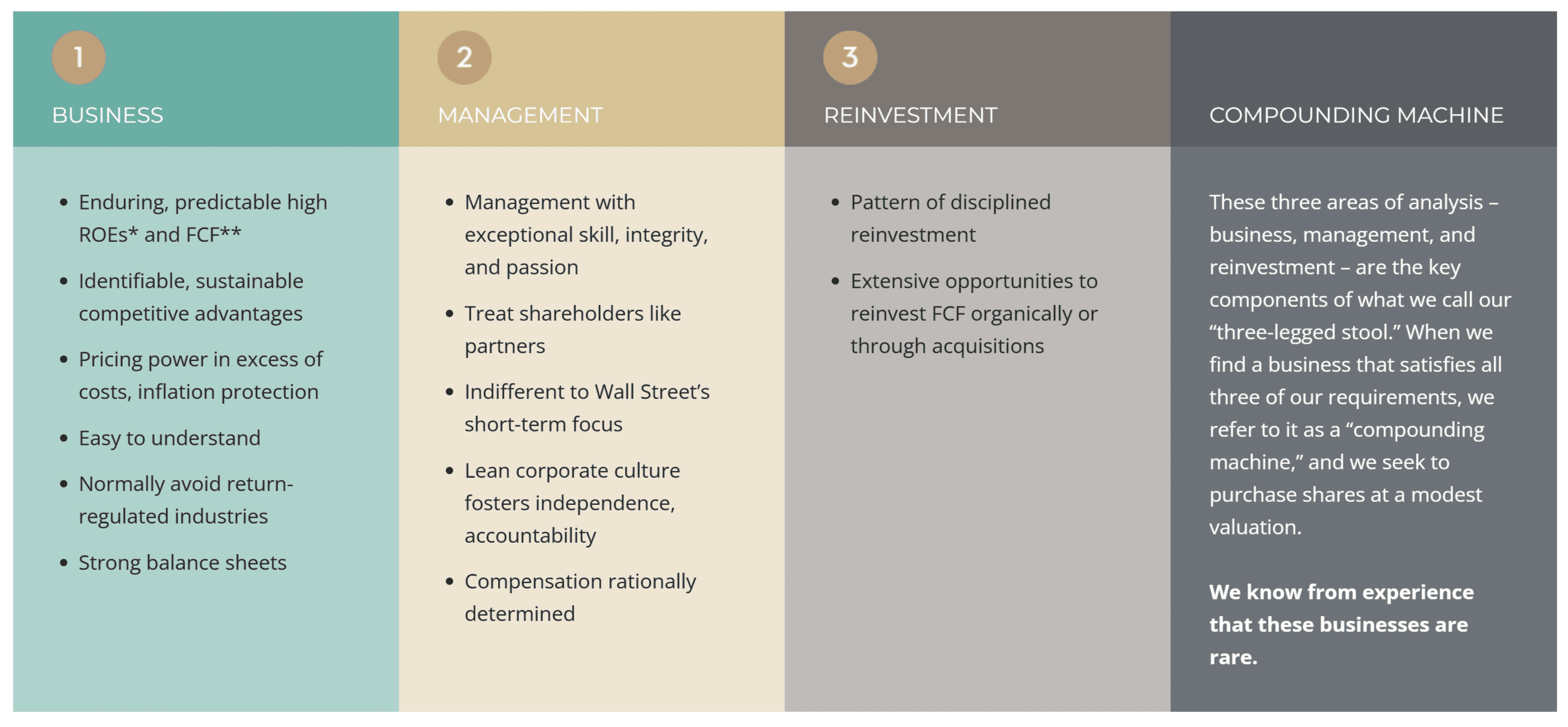
Akre Capital Management is synonymous with “The Three-Legged Stool”.
It’s their investment framework.
The legs are:
Extraordinary business
Talented management team
Reinvestment opportunities
The Akre team walked us through that model. Let’s see what you can learn from this.
How many A.I. stocks belong in a quality portfolio?
And not just how many… but which ones?
Have you been following Pieter’s recent articles and stock picks?
Then it’s not a theoretical question.
In fact, multiple stocks in the Compounding Quality, Compounding Dividends, and Tiny Titans portfolios are heavily involved with Artificial Intelligence (AI).
But what Pieter is thinking about now is way more extreme.
A huge new position… with his own personal cash… in a “pure-play” AI company (a company that’s entirely about AI).
One that has already more than doubled this year.
Has he lost his mind?
His nerve?
Or did he perhaps… lose a bet?
You’ll find out on G-Day, from Pieter himself.
Want to find out more?
Sign up here and get access to the beta version of our e-book: ‘10 Most Dangerous Myths of Growth Investing’.

1. Extraordinary business
The core bedrock of Akre’s philosophy is:
“The bottom line of all investing is rate of return.”
No sense to complicate things, right? It’s as easy as that.
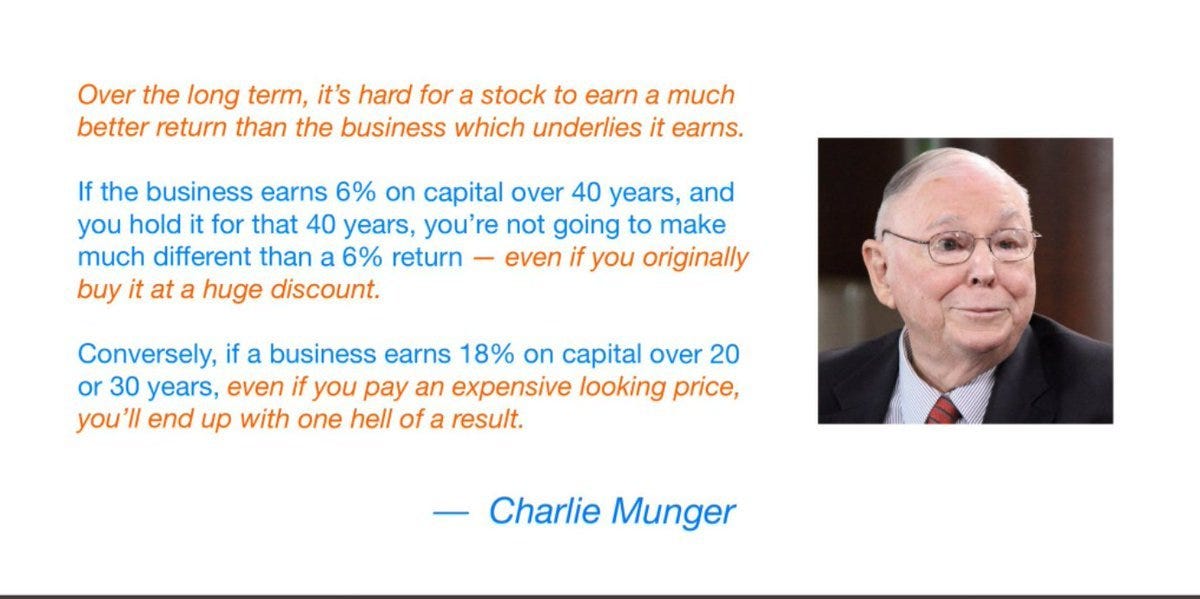
And if you want to earn a good return as an investor, you might as well just pick businesses that earn good returns themselves.
This idea is very similar to what Munger and Buffett use.
They say it’s very hard to earn a good return as an investor in a business that earns a bad return on capital itself.
That’s why the Akre team always looks at the return on Owners’ Capital and return on Total Capital.
The formulas they typically use are:
Return on Owners’ Capital = Free Cash Flow / Shareholders’ Equity
Return on Total Capital = Free Cash Flow / Total Invested Capital
2. Talented management team
The second pillar is a talented management team.
Spotting talented managers is much more subjective.
Akre Capital Management uses an easy, practical tool to assess management.
The more you hear the words “per share” or “EPS”, the more excited you should become.
Business growth is irrelevant if management has to issue new shares all the time.
It’s per share-growth that matters for shareholders, not overall growth.
You can very easily test this yourself.
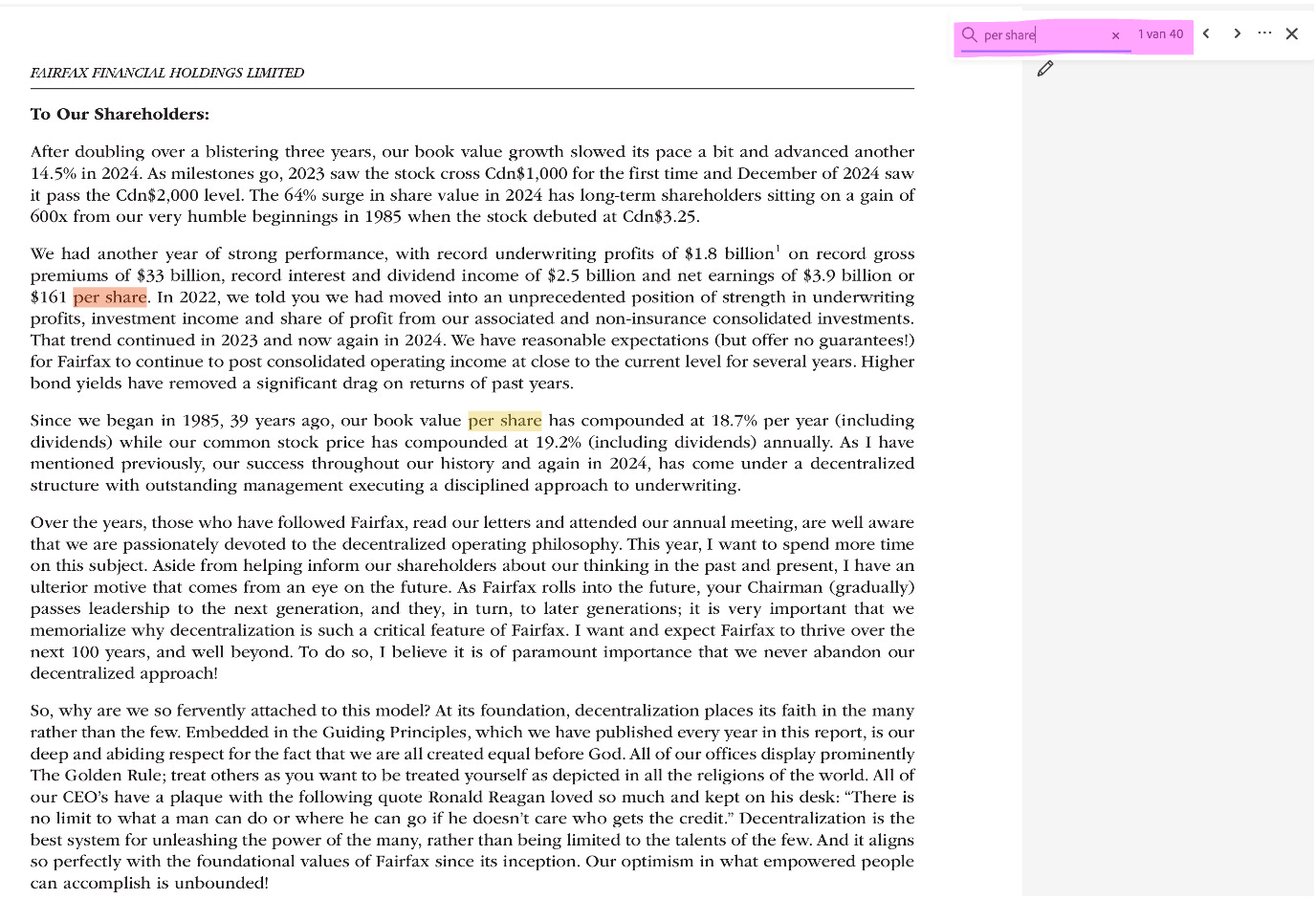
Just open an annual report or earnings call transcript and search for “Per Share” or “EPS” using Command + F.
If there are a lot of matches, it’s likely you have a shareholder-friendly management team.
If there are no matches, the management team probably isn’t shareholder-friendly.
For example, if you open Prem Watsa’s 2024 shareholder letter (Fairfax) and search for “Per Share”, you’ll find 40 matches.
That’s a good sign of shareholder-friendly management.
It suggests that Prem Watsa puts shareholders’ interests first.
3. Reinvestment opportunities
Management can raise money in several ways: by taking on debt, issuing new shares, using cash from the business, or selling assets.
They can also use that money in different ways: buying other companies, buying back shares, paying dividends, investing in growth, or repaying debt.
Deciding where to get money and how to use it is called capital allocation.
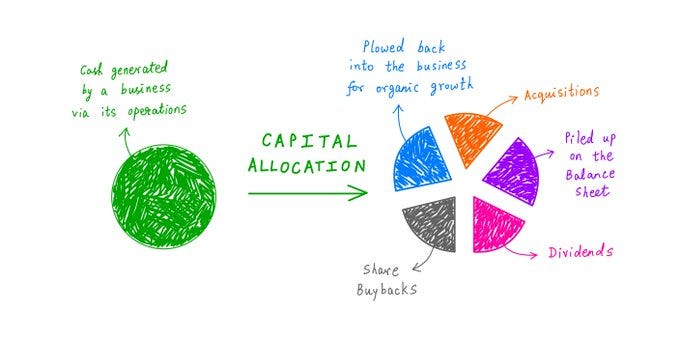
The capital allocation decisions made by management are key for shareholder returns.
What does the Akre team not like as a capital allocation tool? Dividends.
They actively avoid companies where the dividend payout ratio is high or rising quickly.
Instead, they want to invest in companies that can keep reinvesting earnings at high rates.
As Chuck Akre says:
“The ability to earn earnings upon earnings is essentially the definition of a compounding machine.” - Chuck Akre
Some quality investors are not big fans of acquisitions.
But the Akre team is different.
They own several serial acquirers like:
Constellation Software
Topicus
Lumine
Roper
Perimeter Solutions
“Compounding machines”
When you put the three legs of the “Three-Legged Stool” together, you get what the Akre team calls a “Compounding Machine”:
Compounding Machine = High returns on (owners’) capital + talented management + plenty of reinvestment opportunities
Akre on portfolio management
While The Three-Legged Stool is easy to explain, it’s very hard to find companies that meet all three criteria.
If you only invest in the best businesses in the world, your list of potential investments is very short.
Compounding machines are rare.
Let’s translate this into 3 rules the Akre Team uses:
Concentrate your investments
Add to existing positions
Lower your portfolio turnover
1. Concentrate your investments
John Neff used a great analogy to explain concentrated investing: coin flipping.
If you flip a coin, you have a 50% chance of getting heads and a 50% chance of getting tails.
Flip it 500 times, and you’d expect around 250 heads and 250 tails.
The more you flip, the closer you usually get to 50/50.
But flip the same coin just 8 times, and the result can look very different.
You might get 6 heads and 2 tails, or 7 tails and 1 head.
The same idea applies to stocks.
The more stocks you own, the more your portfolio tends to move like the broader market.
A more concentrated portfolio gives you a wider range of possible outcomes: you could outperform the market by more, but you could also underperform by more.
The Akre team believes concentration is key to outperforming.
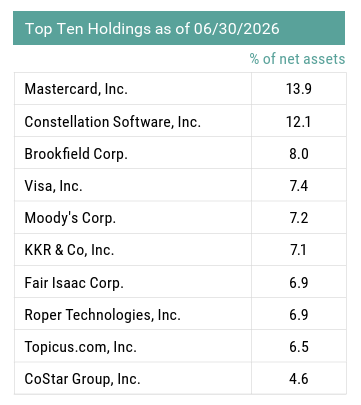
The Akre ETF has almost 50% of its portfolio in just 5 stocks: Mastercard, Constellation Software, Brookfield, Visa, and Moody’s.
2. Add to existing positions
The second idea behind Akre’s portfolio management follows naturally from the first.
If you want a concentrated portfolio, you should spend most of your time adding to existing positions instead of buying new companies.
Part of this is psychological.
It’s exciting to add a new stock to your portfolio.
There’s a certain satisfaction in finding another company to own and growing your “empire.”
But that’s not how you should invest.
You rarely need to open new positions.
Instead, they spend most of their time adding to existing positions.
Their goal isn’t to own more companies.
It’s to own more of their best ideas.
3. Low portfolio turnover
Once you find a compounding machine, you should be very hesitant to sell.
Time is the fuel that powers a compounding machine.
John Neff quoted Chuck Akre himself:
“A 100-bagger is simply a 50-bagger that doubles.” - Chuck Akre
Chuck Akre’s best investment is American Tower. It’s a 200-bagger for him.
The only way to turn an investment into a 200-bagger is to hold on after it becomes a 100-bagger.
Three Stock Picks
To finish the conversation, we asked the million-dollar question:
“If you were stranded on a deserted island and had to invest all your money in one stock, which one would you choose?”
Three interesting ideas were shared.
CoStar (Pitch by John Neff)
How does the company make money?
CoStar is a leading provider of real estate data and analytics, benefiting from growing demand in the digital transformation of the industry.
In 2009, early in his career, John Neff applied to work at Akre’s firm. To convince Chuck Akre, he pitched Moody’s.
Since then, the stock has become a 20-bagger. Moody’s is still a key position in Akre’s portfolio today.
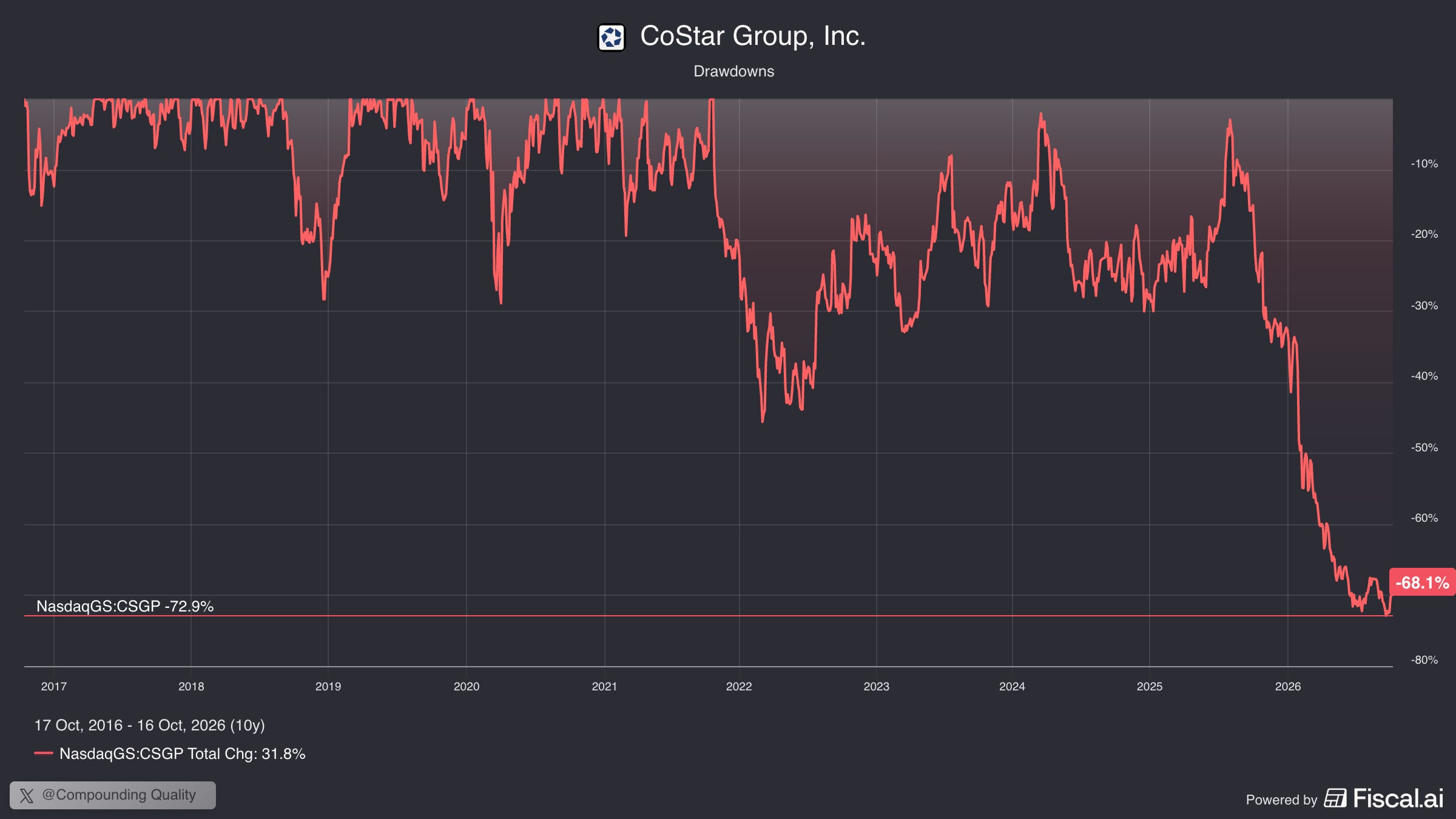
A company Neff is excited about today? CoStar ($CSGP).
CoStar Group is a leading global provider of data and analytics for commercial real estate.
As John Neff puts it: “They are digitalizing real estate.”
CoStar recently had its worst drawdown falling from $94.5 per share to $28.5:
KKR (Pitch by Andrew Millette)
How does the company make money?
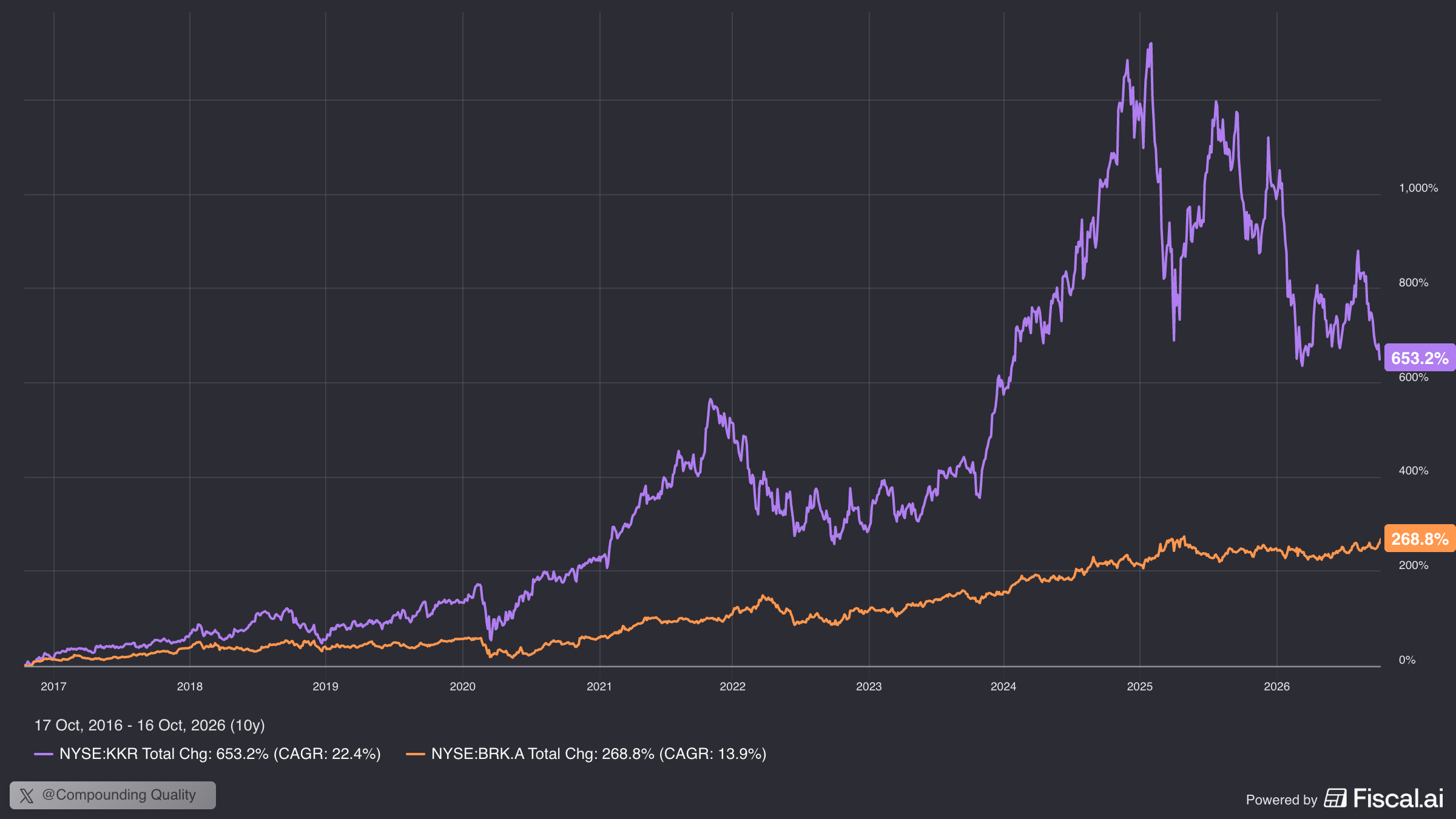
KKR is an American investment company. They use money from big clients (like pension funds) to buy and grow other companies. They also own Global Atlantic, a large insurance operation.
Andrew Millette picked KKR.
The Akre team had recently met with KKR’s management and came away very impressed.
They said KKR is a bit like Berkshire Hathaway, where you can almost blindly trust management to allocate capital well.
Please note KKR is in the Compounding Quality Portfolio too.
Now let’s dive into the final stock pick.
Mastercard (Pitch by Trey Tickner)
How does the company make money?
Mastercard runs a network that connects consumers, merchants, and banks worldwide. They make money by charging a tiny fee on every single transaction that runs through their network.
Trey Tickner picked Mastercard.
One interesting fact the Akre team shared?
The first credit card payment dates to 1950.
It shows how resilient the business model is.
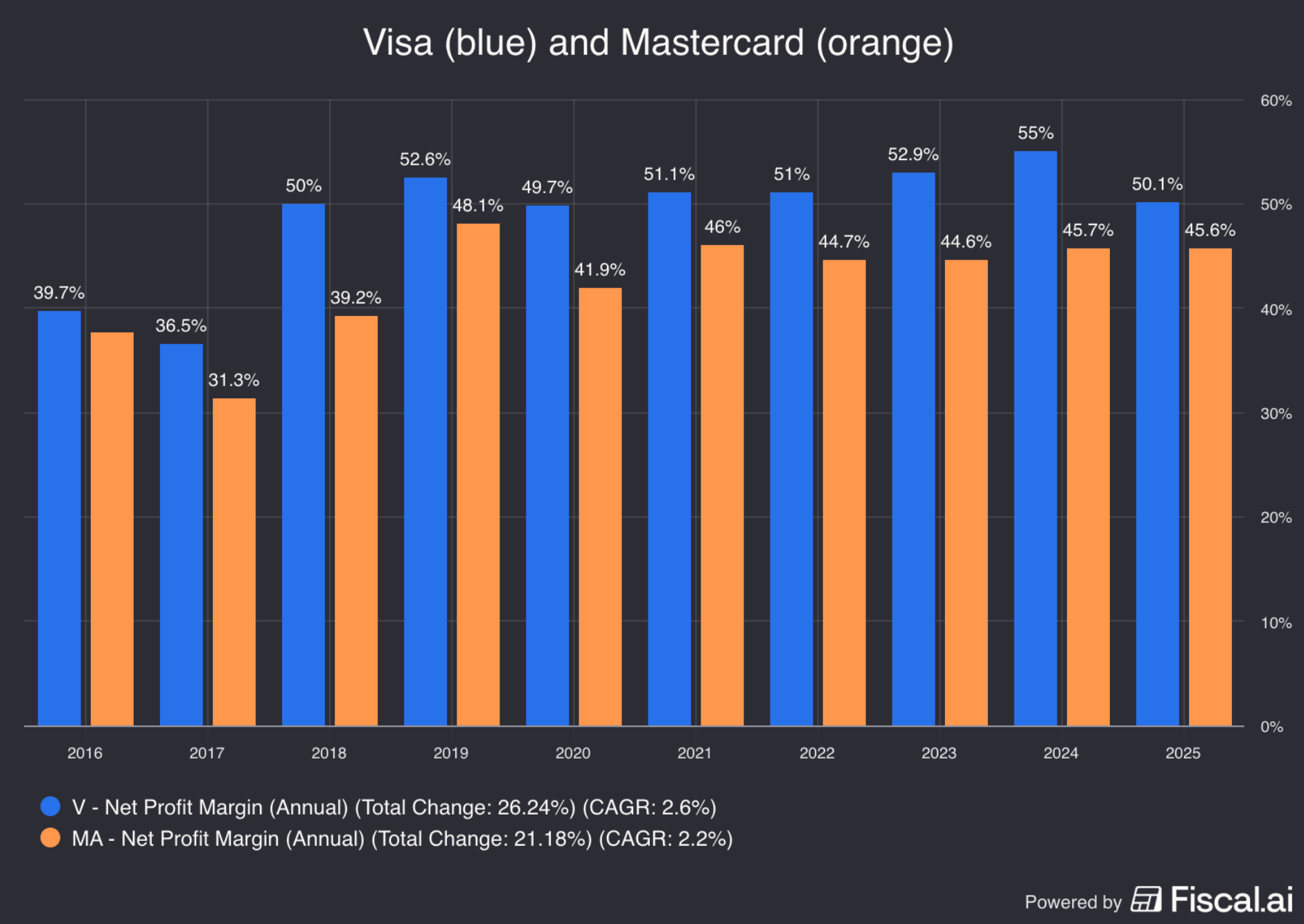
If you didn’t know, one of the most famous Visa and Mastercard quotes comes from Chuck Akre:
“If you cut Visa and Mastercard’s net profit margin in half. And then do it again… You have the profitability of the average U.S. business.”
This quote is now 9 years old. Chuck Akre shared it during a talk at Google.
Since then, Visa and Mastercard have only gotten stronger.
Visa’s net margin is now 50.8%, up from 36.5% when Akre gave the talk.
The average U.S. business has a net margin of 7%-10%.
That means you could now almost cut Visa’s net margin in half three times and still be close to the average U.S. business.
Talking about a compounding machine!
Conclusion
That’s it for today.
Here’s what you can learn from the Akre team:
The Three-Legged Stool:
Extraordinary business: Look for high-quality business with strong returns on owners’ capital
Talented management: Buy companies with strong management teams that think in per-share value
Reinvestment opportunities: Invest in businesses with long runways and a low dividend payout ratio
Portfolio management:
Concentrate your investments: remember the coin-flipping analogy
Add to existing positions: usually, the best investment is a stock you already own, not a new company
Low portfolio turnover: A 100-bagger is a 50-bagger that doubles
Interesting stocks:
CoStar: a business digitalizing real estate
KKR: an almost Berkshire-like capital allocation machine
Mastercard: a credit card business with 4x the Net Margin of the average business
A big thanks to the Akre team for sharing their incredible wisdom!
How many A.I. stocks belong in a quality portfolio?
And not just how many… but which ones?
Have you been following Pieter’s recent articles and stock picks?
Then it’s not a theoretical question.
In fact, multiple stocks in the Compounding Quality, Compounding Dividends, and Tiny Titans portfolios are heavily involved with Artificial Intelligence (AI).
But what Pieter is thinking about now is way more extreme.
A huge new position… with his own personal cash… in a “pure-play” AI company (a company that’s entirely about AI).
One that has already more than doubled this year.
Has he lost his mind?
His nerve?
Or did he perhaps… lose a bet?
You’ll find out on G-Day, from Pieter himself.

Everything in life compounds
Team Compounding Quality
Used sources
Interactive Brokers: Portfolio data and executing all transactions
Fiscal: Financial data