

Hi Partner,
Last week you were able to read Part I of our interview with Kris.
Kris is the best growth investor I know.
He even made a bet with me that Nvidia was undervalued… 3 years ago.
Everybody was already convinced that Nvidia was overvalued. Kris wasn’t.
Nvidia is up almost +400% since then.
Let’s dive into Part II of this interview right away!

Kris just announced his 5 favorite stocks right now.
Curious? Download them for free:

What are the most important metrics or ratios to take into account for growth investors?
Kris: It’s pretty simple: revenue growth. Look at the long-term statistics and you will see that revenue growth is by far the most important driver of stock returns over the long term. Over a year, it’s valuation. But that only counts for 5% over a decade.
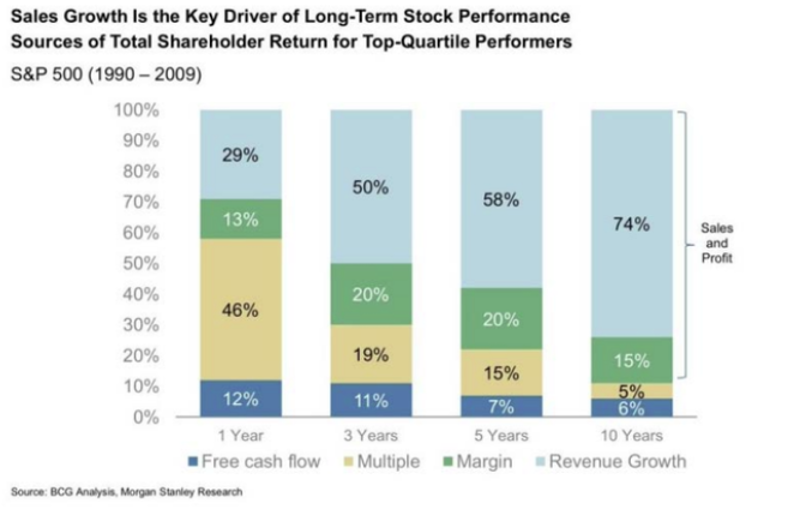
Of course, growth alone is not enough. It’s easy to grow revenue fast if you sell $1 for 90 cents. So you want profitability moving in the right direction. But that doesn’t mean I shy away from unprofitable companies. There are tests to see if an unprofitable company is a good company or not.
My favorite is the rule of 40, which comes from the venture capital world: revenue growth plus free cash flow margin should be above 40. Suppose a company grows revenue by 60% with a free cash flow margin of minus 10%. That’s a rule of 50 and that’s really strong. I would definitely be interested in that company, even if it still loses money.
What would be a reason to sell a position?
Kris: The most important reason is simple: the company doesn’t execute as I want it to execute. That doesn’t mean I sell for every mistake. Every company makes them. You have to be a bit tolerant. But blind tolerance is just hoping, and hope is not a strategy, as we all know.
That’s why I have my self-developed Selling Rules that are very company-specific. I determine beforehand when I will trim or sell. Of course, I don’t follow them blindly, as there are always situations in which you should divert from the rules. Suppose a selling rule is at least 15% revenue growth and the company only grows its revenue by 8% but guides for 25% revenue growth in the next quarter, selling would be stupid.
Next to the Selling Rules, I have also developed a Quality Score. Every quarter, I go through the earnings in an earnings deep dive, and then I score the company on 17 criteria, from quality of management and revenue growth to metrics I’ve developed myself, like sales efficiency scores. This catches slow deterioration in companies, which you don’t always see if you don’t score. If the Quality Score is dropping and too low, or the Selling Rules are broken, I consider selling. But I try to hold companies for a long time, not selling too early. It can cost you much more to sell a Multibagger to early then to hold a loser too long.
Who is the investor you admire the most?
Kris: Potential Multibaggers is highly influenced by three investors.
The first, and the biggest influence, is Phil Fisher. You may know him from Common Stocks and Uncommon Profits, a fantastic book that heavily influenced my views on investing.
The second is David Gardner, one of the co-founders of The Motley Fool and almost as important as Phil Fisher in the development of Potential Multibaggers. He has picked at least seven 100-baggers: Amazon, Nvidia, Tesla, Intuitive Surgical, Netflix, and others. And he does what I also emphasize: hold your stocks for the long term.
Every single one of those fantastic stocks had crushing drops along the way, 80%, 85%, 90%, Amazon almost 95% but David Gardner held the stocks all the way through. If you ever needed proof that holding longer beats selling too early, this is it.
The third influence is Peter Lynch. His level-headedness, his contrarian eye, and in general, he’s simply a very wise man. His influence is more about his mindset than his investing method.
How do you size positions, and does conviction level change the size over time?
Kris: I add when I see a company doing well, and I mean fundamentally, not the stock price. Take MercadoLibre ($MELI). The stock hasn’t done much recently, but the business keeps executing, so I’ve kept adding, even though it’s already my biggest position.
I always rank my portfolio by original allocation, not current value because I refuse to punish my winners and reward the losers. If I ranked by current value, every stock that did great looks like a position that’s too big and every loser like a position that’s too small. That’s not what you want. Based on original allocation, I usually don’t put more than 8% of my portfolio in one stock. Every now and then I stretch to 10%, and with MercadoLibre I’m even above that, which is very exceptional for me.
If a stock does so well that it becomes a 20% position at the current value of the portfolio, I’m fine with that. But that’s very personal. Can you sleep well at night with a 20% position? I can, but it doesn’t mean you can. That’s OK as well. Position sizing is very personal.
Do you have a formal checklist or set of criteria a stock must pass before it makes the portfolio?
Kris: There are 15 Potential Multibaggers criteria, but I wouldn’t call them a formal checklist in the classic sense. The Quality Score and the Selling Rules are more formal, but they come later, once I already have a position.
There are quite a few subjective criteria when I pick a stock. For example, the company must have a great mission statement. This may sound trivial, but companies with a clear purpose simply perform much better. I also look for optionality, smart backing, financial strength, and many more criteria.
I want to mention one in particular: Unscaled scalability. It’s based on Hemant Taneja’s book Unscaled.
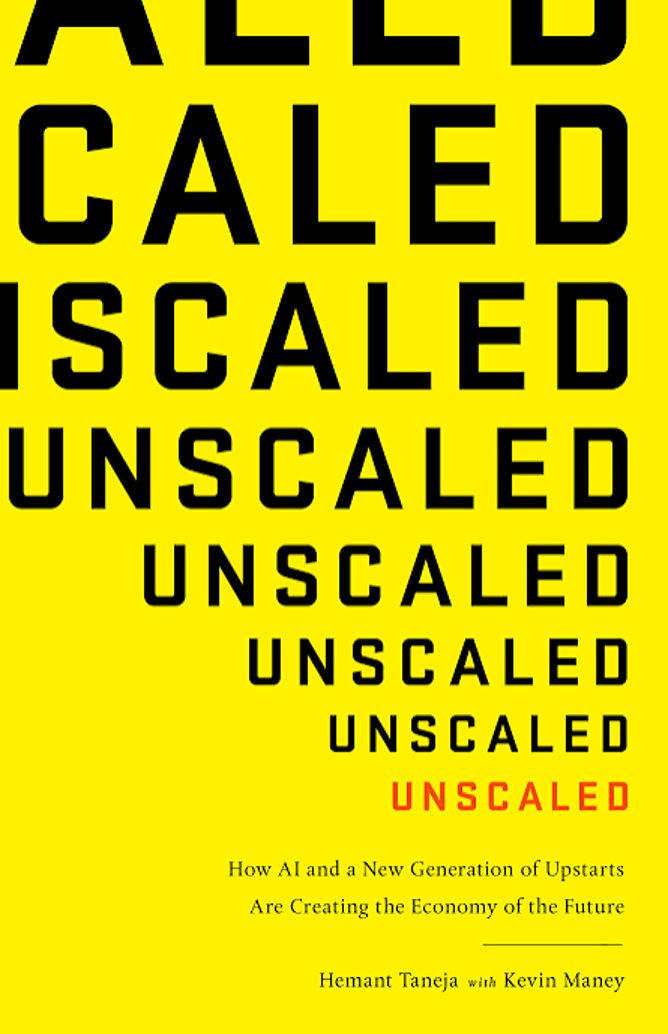
In his book, Taneja argues that scale has become a disadvantage unless you allow consumers to finetune the products to their own needs. That’s unscaled. You could use personalized as a synonym.
Too much differentiation leads to higher costs and less profits. So, that unscaled product should still be spread at large scale. Think of Netflix ($NFLX), for example. Everyone has their own recommendations (unscaled) but Netflix can easily do this for all customers without much extra costs (scaled).
A lot of people talk about growth investing, but few actually stick with it through the drawdowns and still come out ahead. What do you think separates you from most individual growth investors?
Kris: People get scared, and I understand that. As I said, David Gardner held Amazon when it was down 95%. Most people are not able to do that. I’ve had multiple stocks that crashed hard, but I held them as well. Shopify was down 85% in 2022, Cloudflare 83%. Of course, I have my doubts as well during those periods. But I have my Quality Score and my Selling Rules to help me. As long as those are intact, I often add to my position. When it hurts the most, it’s often the best time to buy. Of course, initially, it feels like you are throwing good money after bad, but over the longer term, these buys are the best. Every month, I have a Best Buys Now article and the June 2022 Best Buys Now are up 367% on average, for example. You can download the most recent list here.
Beforehand, most people think they can hold through deep drops. But it’s not only the price drop that makes you sell, it’s the stories surrounding the stock. When a stock is down 50% or more, everything you hear and read about it is extremely negative, and those stories influence your thinking. My edge is that I can put my feelings aside because of the Quality Score and the Selling Rules. Of course, I also know the history of growth stocks, and volatility is just part of this game.
If you read 100 Baggers by Chris Mayer, a fantastic book, you know this. He studied 365 stocks that went up 100x or more. Not one of them avoided a 50% drop. The overwhelming majority was down 75% or more, and not once, but multiple times. That is the price of a 100-bagger, and most people cannot pay it. No pain, no gain, they say, but it’s hard to just suffer without any guidance. That’s what I do for my subscribers.
Conclusion
That’s it for today.
Kris just announced his new top 5 stocks.
Curious? Download them for free:
Everything In Life Compounds
Pieter
Book
Order your copy of The Art of Quality Investing here
Used sources
Interactive Brokers: Portfolio data and executing all transactions
Fiscal.ai: Financial data
Always keep shinning and inspiring us, who has a keen interest in learning.
Thanks @Compounding Dividends
The distinction between tolerating normal volatility and ignoring deteriorating fundamentals stands out. A company specific sell rule, paired with a quarterly quality score, turns “conviction” into something testable instead of emotional. The point about ranking positions by original allocation is useful too.
It helps prevent automatic trimming of the businesses executing best while adding to weaker positions simply because their prices fell.