

Hi Partner 👋
Earlier this week, we looked at what serial acquirers are and why they are interesting.
Today, it’s time for the second article.
You will learn how to identify the best serial acquirers yourself in less than 5 minutes.
Ready. Set. Go!
Invert, always invert
There are probably over 300 public companies that you could label as serial acquirers.
In Sweden alone, you can already find more than 30 of them.
No investor has time to analyze them all.
It’s exactly why your job as an investor is to say no as soon as possible.
The sooner you have found a reason not to invest, the better.
This will give you more time to dive deep in the best ones.
Instead of looking at a “what to look for list” in serial acquirers.
You are going to apply Charlie Munger’s advice: “Invert, always invert”.
“Just constantly invert. You don’t want to think about what you want. You think about what you want to avoid.” - Charlie Munger
Let’s look at a “what to avoid list” for serial acquirers.
Using this checklist, you can say no to 90% of public serial acquirers in just a handful of minutes.
What remains are the good serial acquirers.
Here is the checklist with five reasons to say a quick no:
The dividend payout ratio is too high
Excessive use of debt
Organic growth is poor
They do few, large deals
Too many people at HQ
Let’s now go a little bit deeper into why they are so important.
1. Dividend Payout Ratio is too high
If you are looking at serial acquirers, it helps to substitute the word “dividends” with “leakage”.
At least, that’s the advice of REQ Capital.
REQ Capital is a Norwegian investment firm focused exclusively on serial acquirers.
They wrote a phenomenal 300+ page deep dive on this subject.
One of their most important charts? The one below:
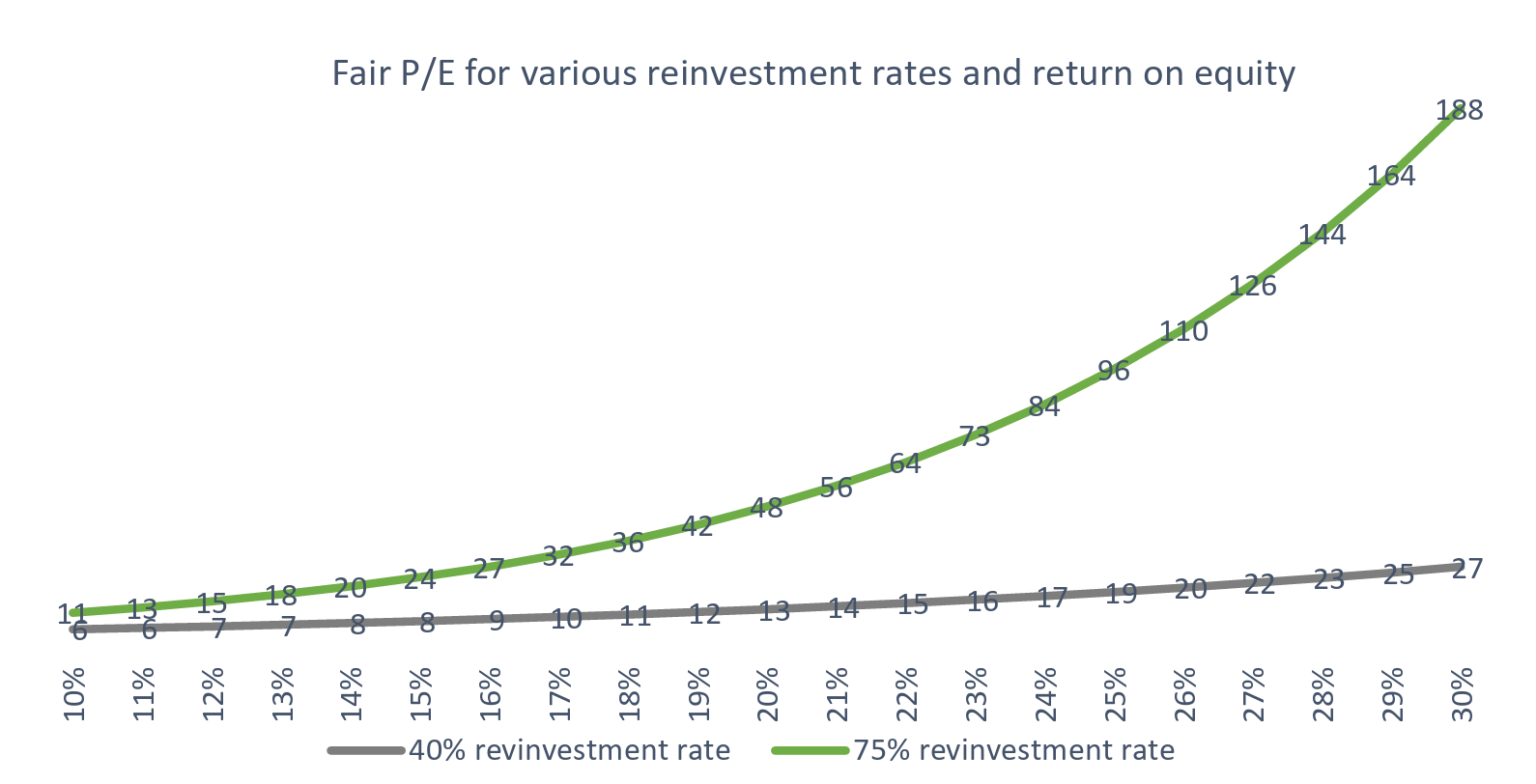
It shows what P/E multiple you can pay to earn a market-like return over 20 years.
This based on the company’s Return on Equity (ROE) and Reinvestment Rate.
Let’s take two examples.
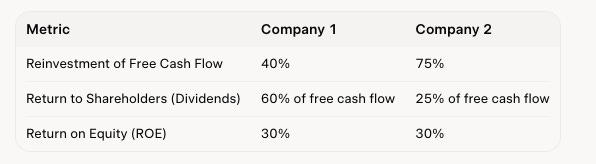
The P/E multiple you can pay for company 1 to earn a market-like return? 27x.
And for company 2? 188x!
This shows the importance of having a high Reinvestment Ratio.
At the same time, you want to avoid serial acquirers with high Dividend Payout Ratios.
The Reinvestment Rate and Dividend Payout Ratio are linked:
Reinvestment Rate = 100% - Dividend Payout Ratio
Dividend Payout Ratio = Dividends Paid/Annual Free Cash Flow
These formulas assume the serial acquirer is not simply accumulating cash
In practice, it shouldn’t take more than 30 seconds to test this.
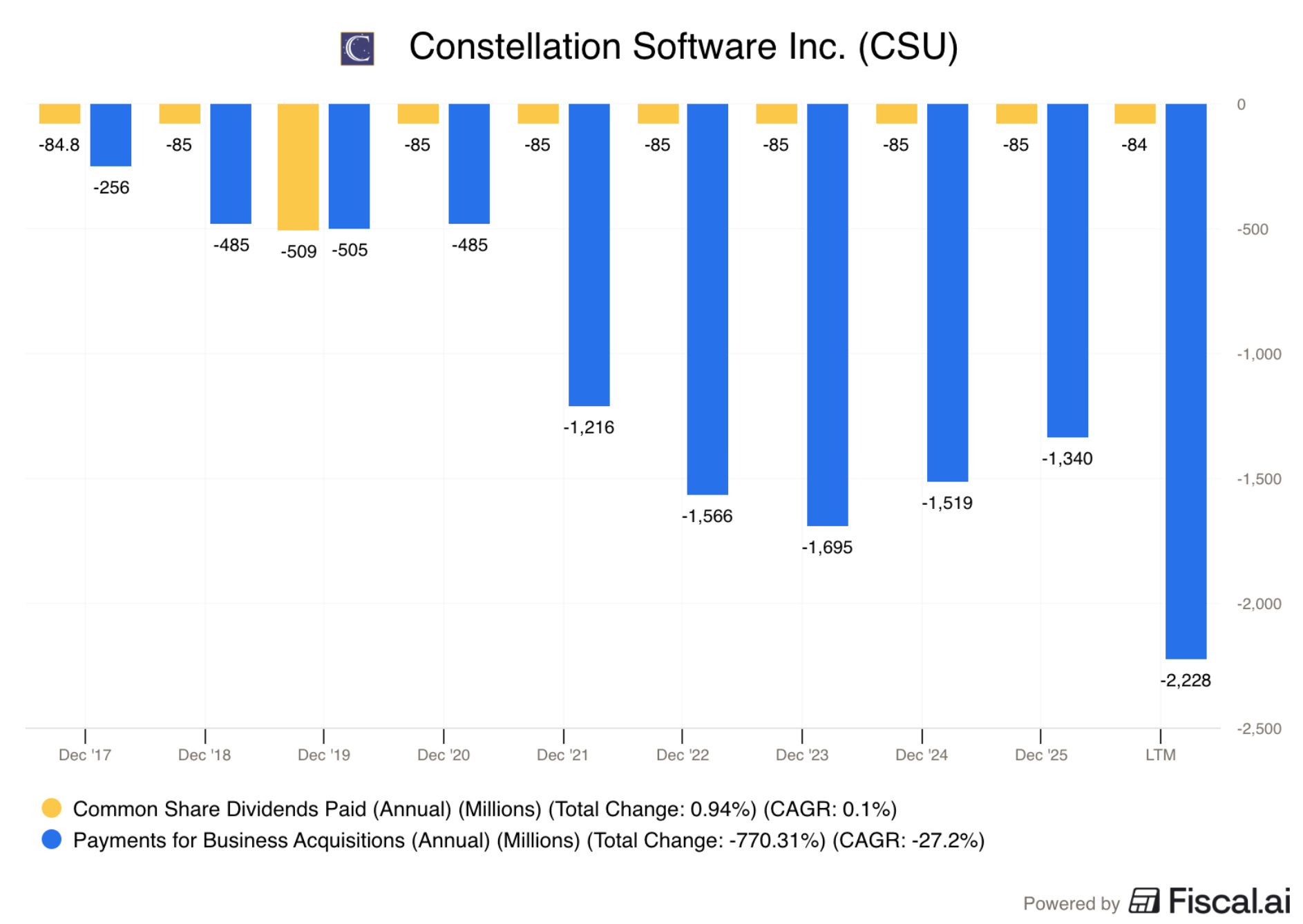
Just go to Fiscal.ai and plot two things:
“Dividends Paid”
“Payments for Business Acquisitions”.
You can find them under “Cash Flow Statement”.
Below is what it looks like for Constellation.
It clearly spends much more on acquisitions (blue) than on dividends (yellow).
That’s what you want to see. The inverse would be a red flag.
2. Excessive use of debt
You can think of serial acquirers as public funds that you invest in.
The only difference? You should substitute “CAGR since inception” and “Assets under Management” with “return since IPO” and “acquisition capital deployed”.
And just like funds, the most interesting time to acquire/invest is often when blood is running down the streets.
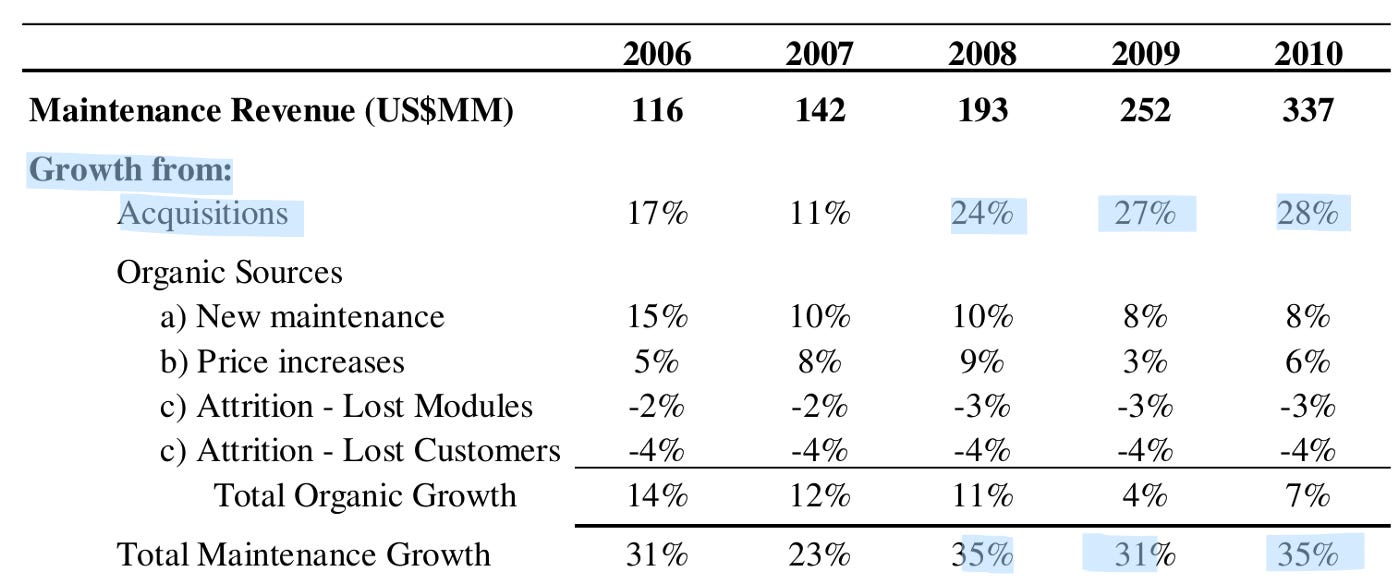
A good example of this is what Constellation Software did during the Great Financial Crisis of 2008-2009.
As you can see below, they ramped up acquisitions and had some of their best years ever.
Mark Leonard (former Constellation CEO) later reflected, saying:
“We did terrific during the 2008-2009 period. We just didn’t deploy enough capital.” - Mark Leonard
In The Outsiders, Will Thorndike also shares this same pattern with two of the best serial acquisition entrepreneurs: John Malone and Warren Buffett.
Just like Leonard, they were incredibly active during the 2008-2009 period.
“Chance favors . . . the prepared mind,” and speaking of prepared minds, let’s conclude by looking at how the two remaining active outsider CEOs, Warren Buffett and John Malone, navigated the financial meltdown that followed the September 2008 collapse of Lehman Brothers.
As you would expect, both pursued dramatically different courses from their peers’. At a time when virtually all of corporate America was sitting on the sidelines, shepherding cash, and nursing ailing balance sheets, these two lions in winter were actively on the prowl.
Buffett, after a long period of relative inactivity stretching back to the immediate aftermath of 9/11, has had one of the most active periods of his long career. Since the fourth quarter of 2008, he has deployed over $80 billion (over $15 billion of it in the first twenty-five days after the Lehman collapse) in a wide variety of investing activities.” - The Outsiders by Will Thorndike
Something Leonard, Buffett, and Malone had in common?
Healthy balance sheets.
It allowed them to, as Buffett would say, “be greedy when others are fearful”.
This is exactly the reason why you should avoid serial acquirers with excessive debt.
At times when it’s most interesting to ramp up acquisitions, they are frozen because they already carry too much debt.
You should always remember the 3 C’s:
Courage + Cash + Crisis = Opportunity
This rule of thumb is just as true for a serial acquirer as it is for you as an investor.
Many serial acquirers have the courage during a crisis, but they don’t have the cash because of their weak Balance Sheet.
Leonard, Malone, and Buffett did.
Case study: TransDigm ($TDG)
Internally, we have been discussing TransDigm recently (click for an extensive investment case).
We were seriously considering them as a potential addition to Our Portfolio.
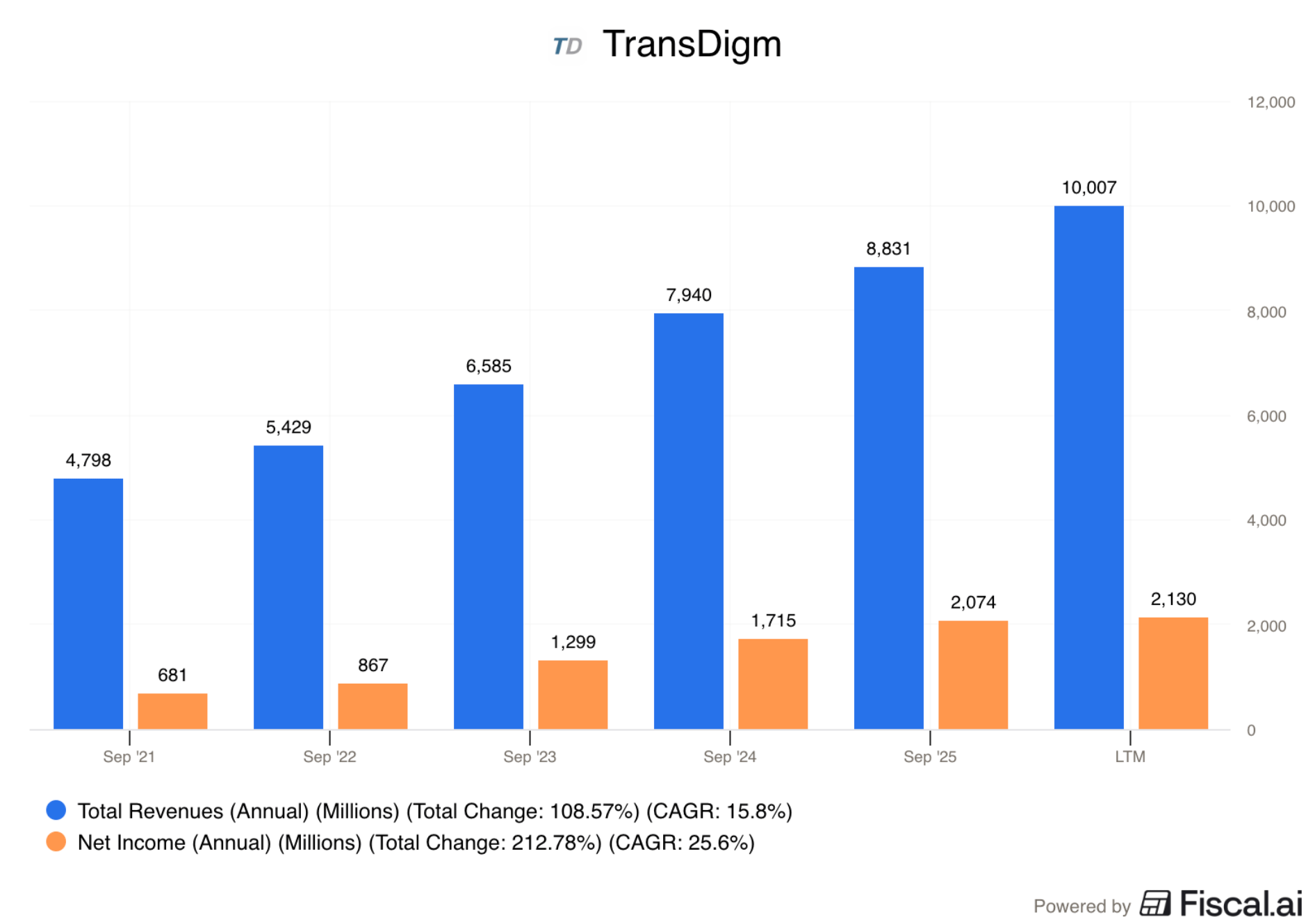
Why? It’s probably one of the highest-quality serial acquirers that keeps generating shareholder value:
But the combination of large dividends and excessive debt made TransDigm an easy no for us.
Just take a look at this chart:
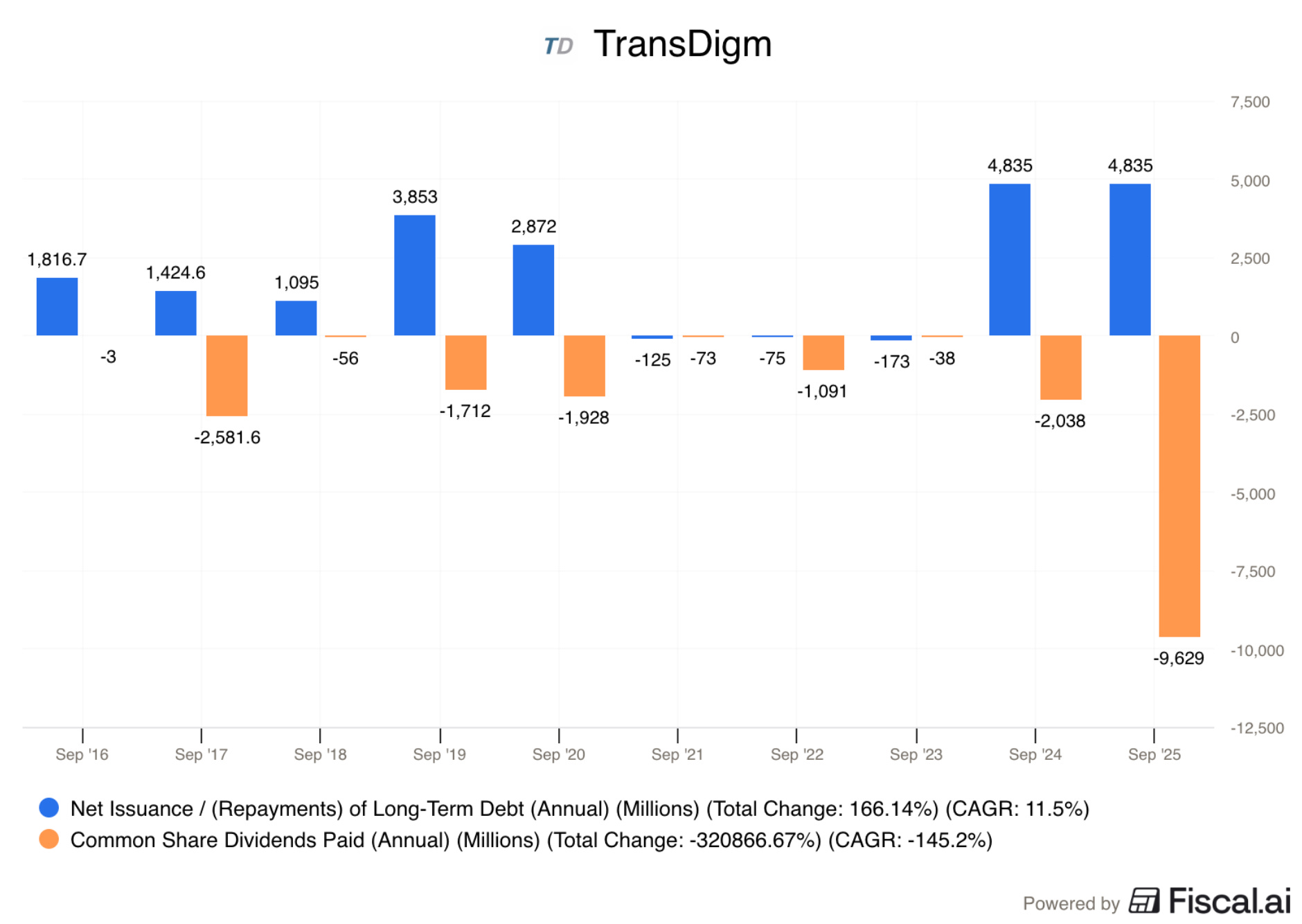
How should you read this chart?
Blue bars show Net Debt Issuance: the difference between the debt TransDigm adds to its balance sheet and the debt it repays. A positive number means TransDigm is taking on more debt than it is paying back.
Orange bars show dividend payments
In other words, TransDigm has recently taken on a significant amount of debt to fund a large special dividend.
If you buy TransDigm today, you don’t get the benefit of that dividend. But you do have to live with the debt that funded it and the large interest expenses.
Net Debt/EBITDA currently stands at 6.0x.
Interest expense was almost 40% of EBITDA in the latest quarter.
This leaves very little EBITDA converting into Free Cash Flow.
As a result, Net Debt/FCF is now above 16x!
In addition, TransDigm may have the courage to act during a crisis, but it doesn’t have the cash to “be greedy when others are fearful.”
Constellation and Topicus do.
As phenomenal as TransDigm is, it was a quick no for us.
Again, investing means saying no as soon as possible.
3. Organic growth is poor
In his H1 2026 review, Matthias Riechert said something really important about serial acquirers.
For those unaware, Riechert is a great serial acquirer investor.
Here is what he had to say:
“The headline is always: serial acquirer A buys company B at a multiple of X times EBITDA. The much more important multiple, as Riechert says, and what many acquirers don’t talk about, is what is the multiple on EBITDA 5 years after the acquisition. In other words, how well do these acquired companies perform after acquisition?”
What did he mean by this? Closing the acquisition is the easy part.
The hard part is actually improving acquired businesses. That’s where most of the value is created.
A quick checkup to see how acquired businesses are performing is to look at organic growth.
In an ideal world, you only want to invest in serial acquirers where the organic growth rate is consistently above the inflation rate.
Aim for acquirers that post 2-5% organic growth annually (or higher).
As an example, here is what Topicus’ organic growth looks like:
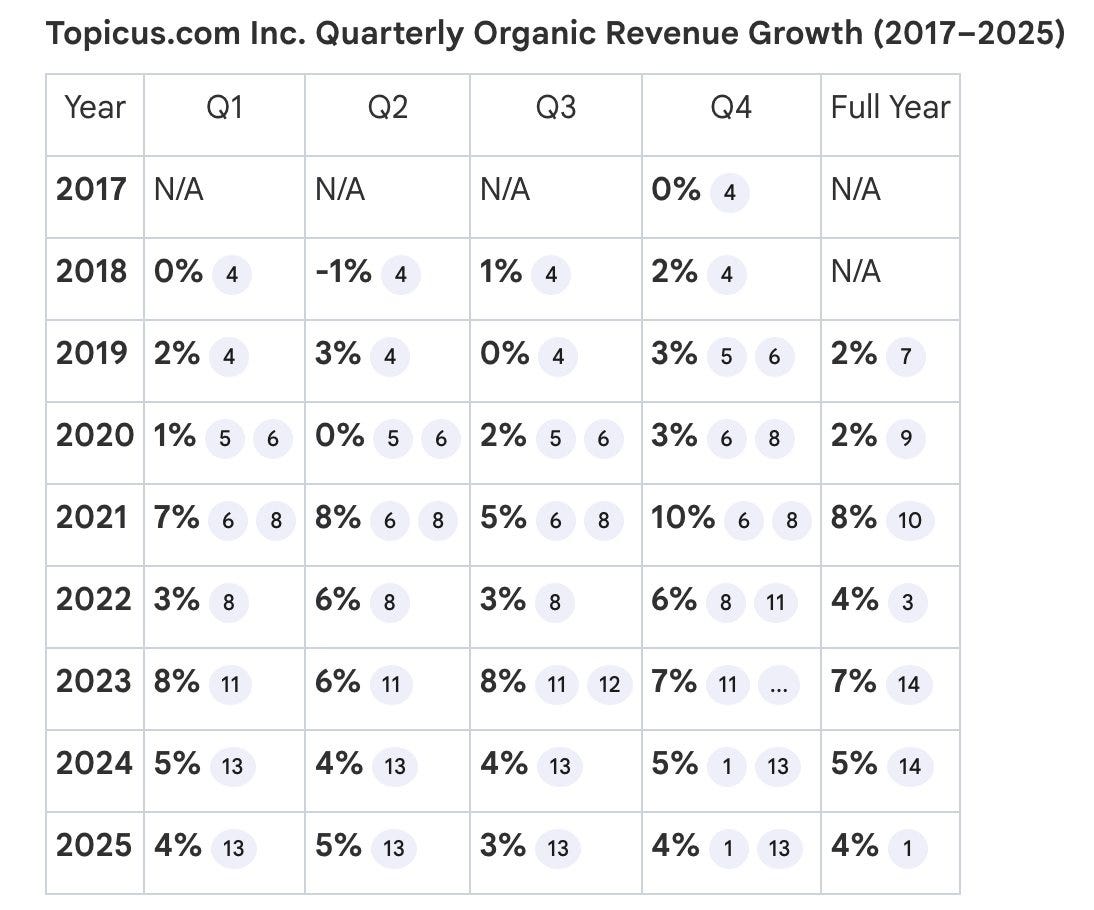
You don’t fall off your chair seeing these organic growth rates.
But more importantly, Topicus never has terrible years regarding organic growth.
It’s consistently in the 2-5% range (or higher).
That’s exactly what you want to see.
4. They do few, large deals
It’s time to look at some research on serial acquirers.
The next two charts are incredibly important.
Charts 1 and 2 plot ROIC (and organic growth) on the Y-axis relative to capital deployed on acquisitions on the X-axis.
And there seems to be a very clear pattern: the more capital serial acquirers deploy, the lower the ROIC and organic growth become.
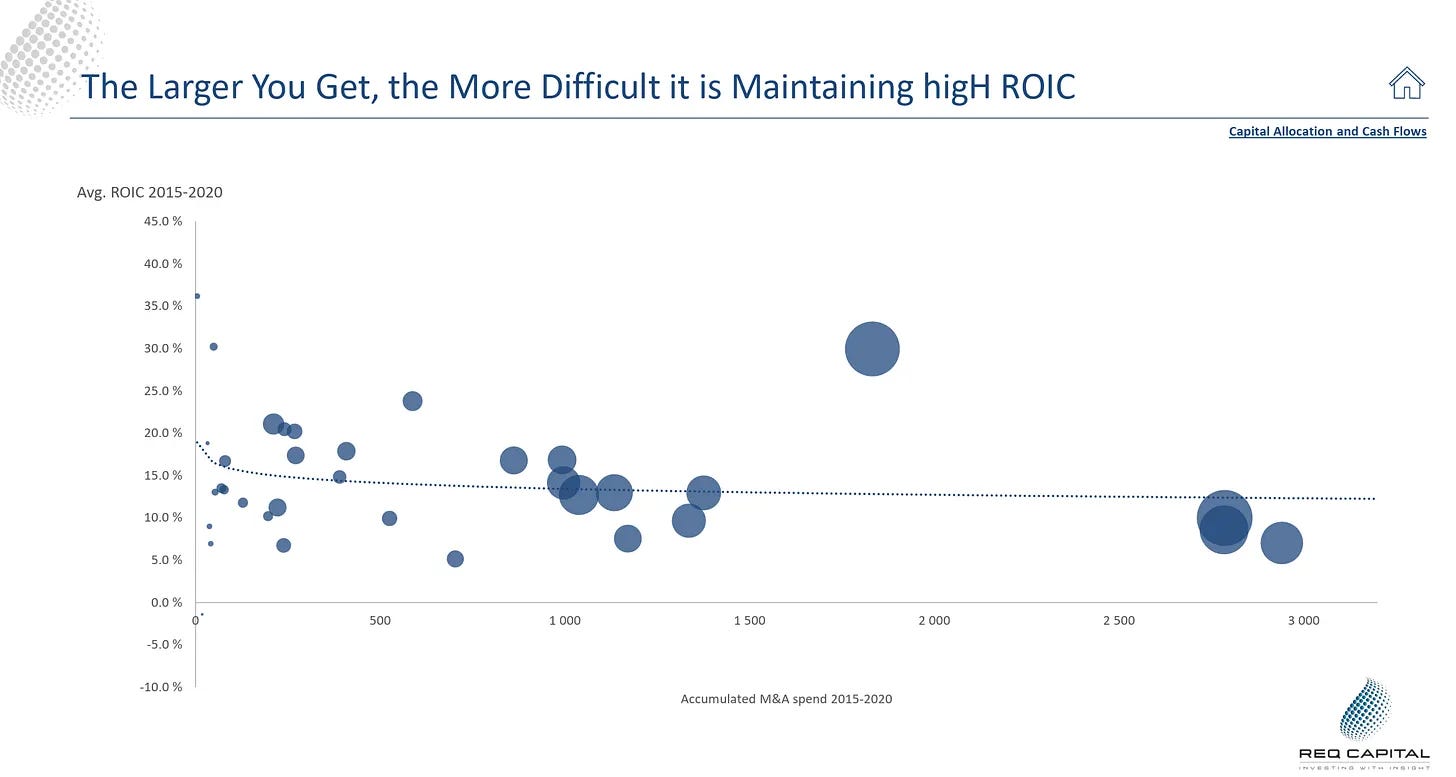

Chart 2 also shows one clear outlier: Constellation Software ($CSU). It keeps generating a high ROIC as it scales.
Why is that? Let’s look at Chart 3.
It shows the average deal size. And again, Constellation stands out.
As Constellation has grown, it has continued to make more acquisitions each year without increasing the average deal size too much.
A year with 100+ acquisitions isn’t abnormal for Constellation. Think about this: almost one out of three days, they close an acquisition.
That’s very different from other large serial acquirers. As they scale, they don’t do more acquisitions. They simply make larger acquisitions.
And larger acquisitions typically generate poorer returns. As the rule of thumb in M&A goes:
“The larger the acquisitions and the further away from your core business, the lower the returns will be.” - M&A rule of thumb

Interestingly, McKinsey found the same pattern in an incredible research piece on M&A.
As you can see below, programmatic M&A tends to generate the highest returns:
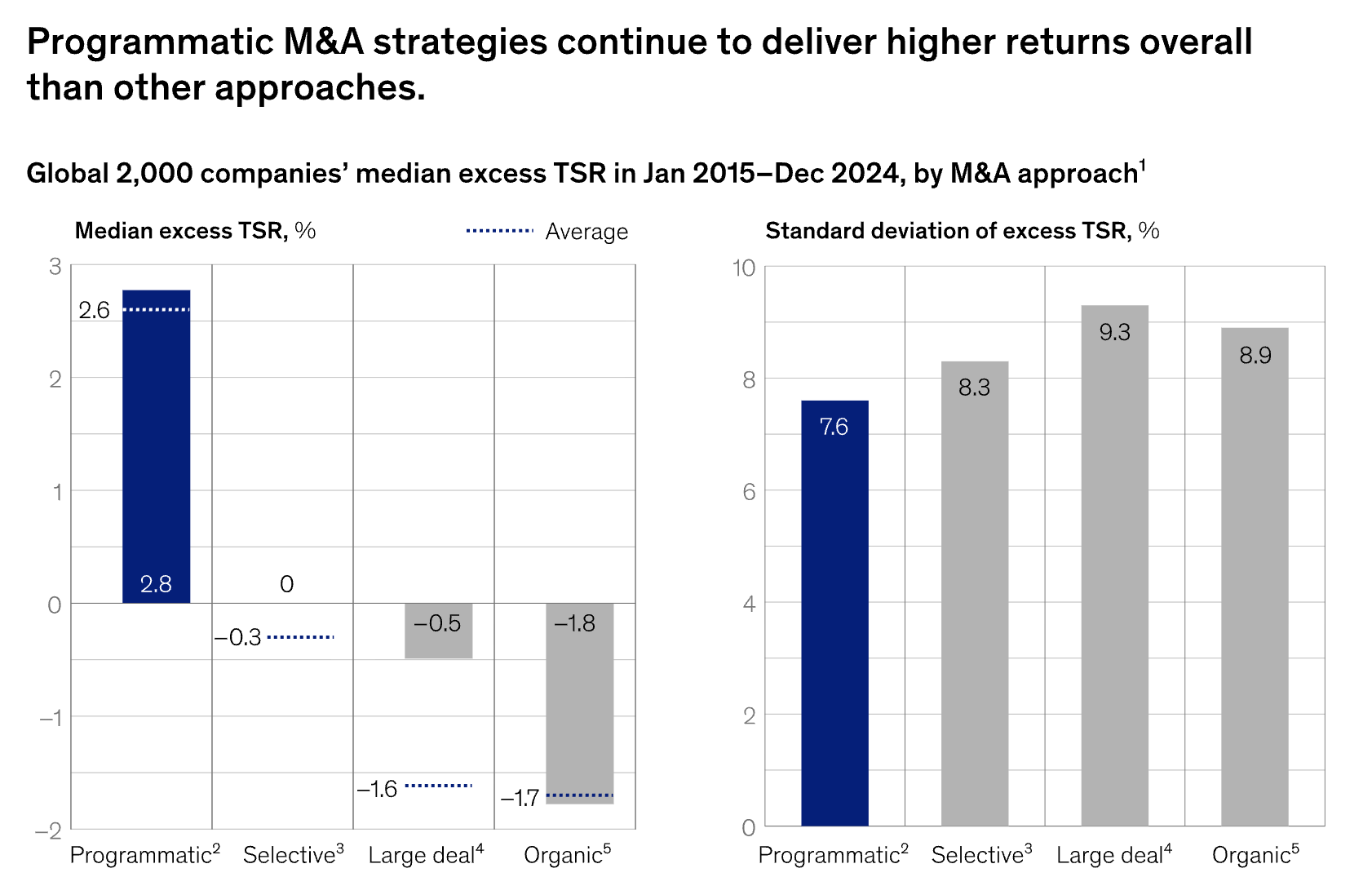
In other words, this was their key finding: