Kinsale Capital: Niche Mastery, Compounding Success
Investment case Kinsale Capital (Part 2)
Hi Partner 👋
I’m Pieter and welcome to a 🔒 subscriber-only edition 🔒 of Compounding Quality.
In case you missed it:
If you haven’t yet, subscribe to get access to these posts, and every post.
Kinsale Capital is a Compounding Machine for sure.
The founder Michael Kehoe is still the current CEO
Kinsale Capital is a clear market leader in a niche
Their underwriting is far superior compared to peers
Let’s dive in!

Is management capable?
Kinsale Capital is an Owner-Operator stock.
Michael Kehoe founded the company in 2009 and he is still the CEO and President.
Today, Kehoe owns 4.0% of Kinsale Capital.
In total, all executive officers and directors own 5.6% of the business.
Kinsale Capital also benefits from an experienced and cohesive management team. The average manager has over 30 years of relevant experience. What’s also positive is that Michael Kehoe and Brian Haney worked together for over 20 years (since 2002).
As you can see, many employees of Kinsale worked together for decades at other E&S insurance companies:
I believe Kinsale Capital has an excellent culture. The company wants to hire young talent and promote from within.
Employees give Kinsale Capital a good score on Glassdoor:
Does Kinsale Capital have a competitive advantage?
Kinsale Capital is a clear market leader in a niche (insuring excess and surplus lines in the United States).
Kinsale Capital has a moat based on 4 main factors:
Leveraging its technology to generate superior data, insights, and services
Exclusive focus on the E&S market (a more profitable segment within insurance)
Vigilantly controlling expenses (resulting in a lower expense ratio versus competitors)
Focus on small accounts (Kinsale is a market leader in this underserved niche)
Over the years, Kinsale Capital has built a proprietary technology platform that reflects the best practices of its management team and has learned from its extensive prior experience.
Kinsale operates on an integrated digital platform with a data warehouse that collects statistical data.
The platform provides high efficiency, accuracy, and speed across all processes.
Management believes its technology platform will provide them with an enduring competitive advantage. It allows them to respond to market opportunities quickly and will continue to scale as the business grows.
In Part 1, you learned that the most important metric for an insurance company is the Combined Ratio.
The combined ratio is calculated by taking all the expenses and losses an insurance company makes from paying out claims and dividing this number by all the premiums they receive from their insurance policies.
In other words: the combined ratio is the sum of the loss and expense ratio.
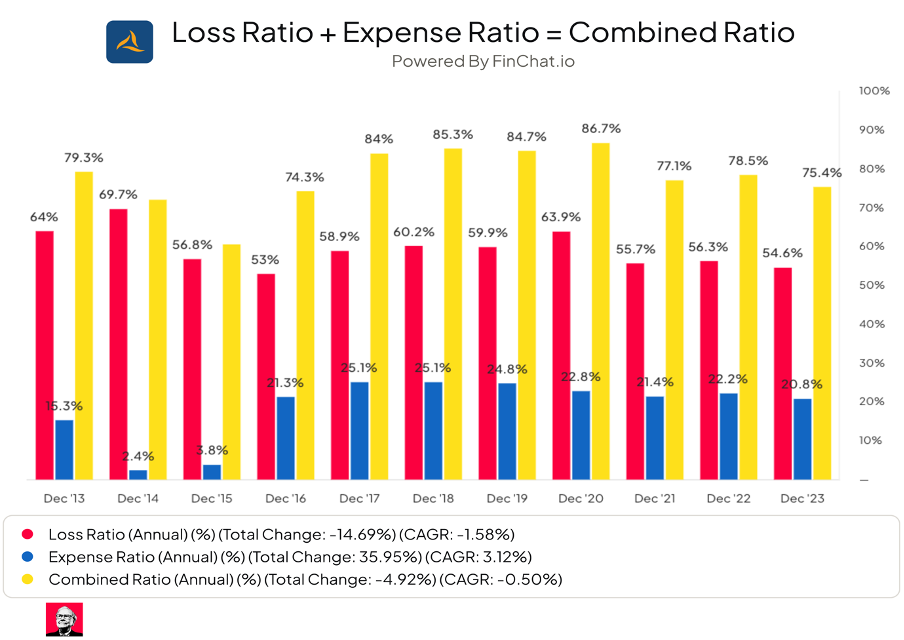
Source: Finchat
The lower this ratio, the better.
A combined ratio under 100% indicates that the insurance company is profitable and the other way around.
And guess what makes Kinsale Capital unique…?
Hi Partner 👋
I’m Pieter and welcome to a 🔒 subscriber-only edition 🔒 of Compounding Quality.
In case you missed it:
If you haven’t yet, subscribe to get access to these posts, and every post.
Kinsale Capital is a Compounding Machine for sure.
The founder Michael Kehoe is still the current CEO
Kinsale Capital is a clear market leader in a niche
Their underwriting is far superior compared to peers
Let’s dive in!
Is management capable?
Kinsale Capital is an Owner-Operator stock.
Michael Kehoe founded the company in 2009 and he is still the CEO and President.
Today, Kehoe owns 4.0% of Kinsale Capital.
In total, all executive officers and directors own 5.6% of the business.
Kinsale Capital also benefits from an experienced and cohesive management team. The average manager has over 30 years of relevant experience. What’s also positive is that Michael Kehoe and Brian Haney worked together for over 20 years (since 2002).
As you can see, many employees of Kinsale worked together for decades at other E&S insurance companies:
I believe Kinsale Capital has an excellent culture. The company wants to hire young talent and promote from within.
Employees give Kinsale Capital a good score on Glassdoor:
Does Kinsale Capital have a competitive advantage?
Kinsale Capital is a clear market leader in a niche (insuring excess and surplus lines in the United States).
Kinsale Capital has a moat based on 4 main factors:
Leveraging its technology to generate superior data, insights, and services
Exclusive focus on the E&S market (a more profitable segment within insurance)
Vigilantly controlling expenses (resulting in a lower expense ratio versus competitors)
Focus on small accounts (Kinsale is a market leader in this underserved niche)
Over the years, Kinsale Capital has built a proprietary technology platform that reflects the best practices of its management team and has learned from its extensive prior experience.
Kinsale operates on an integrated digital platform with a data warehouse that collects statistical data.
The platform provides high efficiency, accuracy, and speed across all processes.
Management believes its technology platform will provide them with an enduring competitive advantage. It allows them to respond to market opportunities quickly and will continue to scale as the business grows.
In Part 1, you learned that the most important metric for an insurance company is the Combined Ratio.
The combined ratio is calculated by taking all the expenses and losses an insurance company makes from paying out claims and dividing this number by all the premiums they receive from their insurance policies.
In other words: the combined ratio is the sum of the loss and expense ratio.
Source: Finchat
The lower this ratio, the better.
A combined ratio under 100% indicates that the insurance company is profitable and the other way around.
And guess what makes Kinsale Capital unique…?
… They have one of the best Combined Ratios in the industry!
Over the past 10 years, Kinsale Capital’s combined ratio averaged 78% and the combined ratio has never been higher than 86% over the past decade.
This is truly great for an insurance company.
Here are the key reasons why Kinsale’s loss ratio (and as a result its combined ratio) is so low:
Kinsale is the only publicly traded insurer that solely focuses on E&S insurance
They focus on small- and mid-sized companies. The average premium per policy is equal to $15,000. This is a relatively smaller market with less competition (market leader in a niche)
All premiums are written in-house while most other insurers outsource this
Kinsale focuses relentlessly on keeping costs low
Kinsale works fast. They usually provide quotes within 24 hours. As a result, brokers get paid faster. With other underwriters, it can take weeks before you get a quote
Kinsale in-houses all its IT infrastructure
A high Return On Equity (ROE) in combination with a Combined Ratio consistently lower than 100% makes Kinsale Capital a quality business.
As you can see here, Kinsale Capital has the lowest combined ratio amongst its peers:
Some additional advantages:
Fully integrated claims management: actively managing claims results in more favorable outcomes and more reserve accuracy. All claims are managed in-house and aren’t delegated to third parties
Entrepreneurial management team with a great track record: highly experienced management team with an average of over 30 years of relevant experience. Management has skin in the game too.
Relentless focus on expense management (keeping costs low)
Is Kinsale active in a competitive environment?
According to A.M. Best, the total E&S market has a size of approximately $82.7 billion in written premiums.
This indicates Kinsale Capital has an implied market share of 1.3%.
KNSL focuses solely on the Excess and Surplus (E&S) market, a rapidly expanding niche.
Over the past 34 years, the E&S market has grown approximately 16 times in size. On its turn, the Property & Casualty (P/C) industry has grown at a much slower rate of about 4 times.
As you can see here, the E&S market is growing at attractive rates:
Kinsale Capital focuses exclusively on the E&S market and on its high levels of service, including its ability to quote, underwrite, and bind insurance policies promptly through its systems.
This allows Kinsale to serve its brokers well and position them to increase its market share.
What’s also attractive is that the E&S market historically operates at lower loss ratios and higher margins.
E&S Insurance:
Loss ratio: 69.5%
Growth in premiums past 20 years: 9.1%
Property and casualty (P&C insurance):
Loss ratio: 73.5%
Growth in premiums past 20 years: 4.0%
Rivals
Competition is based on many factors:
Perceived market strength of the insurer
Pricing
Services provided
Speed of claims payment
Reputation
Experience of the insurer
Ratings assigned by independent organizations such as A.M. Best
…
Kinsale Capital currently has an “A” (Excellent) rating on A.M. Best Ratings.
Primary competitors in the E&S sector include Arch Capital Group, Argo Group, James River Group, Lloyds of London, Markel Corporation, RLI Corp., and W. R. Berkley Corporation.
In the E&S market, Kinsale Capital is the only publicly traded pure-play:
What are the main risks for Kinsale?
Here are some of the main risks for Kinsale Capital:
Dependence on general economic conditions (recessions, inflation, periods of high unemployment, lower economic activity, …)
Kinsale Capital keeps fewer reserves compared to peers
Insurance is a cyclical business (year-on-year results are unpredictable)
E&S insurance covers risks that are typically more complex and unusual than standard risks. They require a high degree of specialized underwriting
Historically, the financial performance of the P&C insurance industry has tended to fluctuate in cyclical periods of price competition and excess capacity (known as a soft market) followed by periods of high premium rates and shortages of underwriting capacity (known as a hard market).
Severe weather conditions, catastrophes, pandemics, and similar events
Kinsale Capital relies on a select group of brokers. Kinsale Capital is somewhat reliant on these distribution channels
Concentration risk: last year, 58.5% of gross written premiums were distributed through 5 of their 179 brokers.
Kinsale Capital invests its float. This means they are exposed to investment risks
Loss reserves may be inadequate to cover actual losses. This could negatively impact the financial conditions of Kinsale
The impact of climate change (more natural disasters?)
Adverse economic factors (recessions, inflations, periods of high unemployment, lower economic activity, …)
The business is cyclical
E&S insurance covers risks that are typically more complex and unusual than standard risks and require a high degree of specialized underwriting. As a result, E&S risks do not often fit the underwriting criteria of standard insurance carriers and are generally considered higher risk than those covered in the standard market.
Kinsale is subject to extensive regulation, which may adversely affect our ability to achieve our business objectives
While Kinsale does almost everything in-house, they outsource their investments. The company just started a small investment group in-house and plans to grow it in the years ahead
Conclusion Deep Dive Part 2
Here are the key takeaways:
✅ Kinsale Capital is an Owner-Operator stock. Michael Kehoe founded the company in 2009 and he’s still the CEO and President
✅ The company is a market leader in a niche (insuring excess and surplus lines in the US). Kinsale has the lowest combined ratio in the industry
✅ Kinsale Capital has an implied market share of 1.3% with plenty of room for growth. In the E&S market, Kinsale Capital is the only publicly traded pure-play.
✅ Succession risk and the cyclicality of the insurance business are the two main risks for the company
👉 If you enjoy reading this post, share it with friends! Or feel free to click the ❤️ button on this post so more people can discover it on Substack 🙏
Join the community
You didn’t join the Community yet?
It’s as valuable as the newsletter itself.
You can join here:
Used sources
Interactive Brokers: Portfolio data and executing all transactions
Finchat: Financial data


